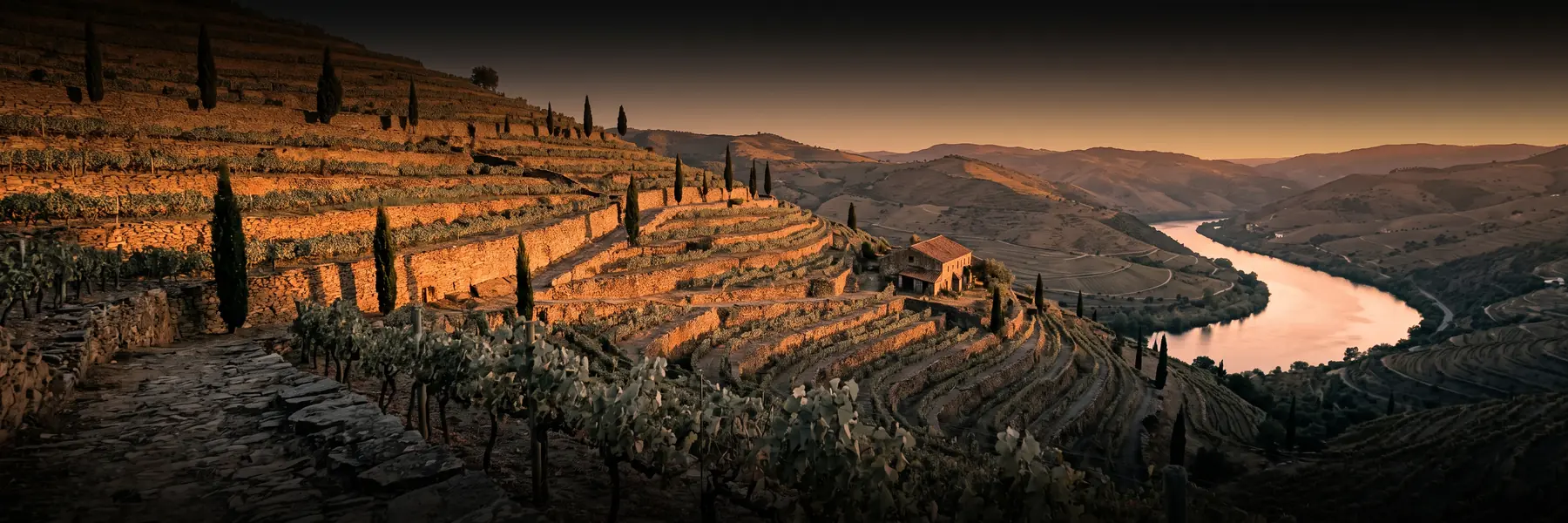
Vouvray — Chenin Blanc From Bone Dry to Nectar
Vouvray — Chenin Blanc From Bone Dry to Nectar
No other appellation in the world does what Vouvray does. From one grape variety on one plateau, a single grower may produce a bone-dry still white, an off-dry one, a lusciously sweet one and a sparkling wine — all in the same year, from the same vines, and all recognisably Vouvray. The variety that makes this possible is Chenin Blanc, and its gift is an acidity so high that it can carry enormous quantities of sugar without ever tasting cloying.
Geography
Vouvray sits on the right bank of the Loire just east of Tours, on a plateau above the river and the Brenne valley. The rock is tuffeau — a soft, porous, chalky limestone that has been quarried here for a thousand years to build the châteaux of the Loire.
Tuffeau does three jobs. It gives the vines a well-drained, limestone-rich rooting medium; the quarries left behind make cool, humid, naturally temperature-stable cellars carved directly into the hillside, ideal for long ageing; and its porosity holds enough moisture to see vines through dry summers.
The style spectrum
Vouvray is labelled by sweetness, and reading the label matters:
| Label term | Roughly |
|---|---|
| Sec | Dry |
| Sec-tendre | An informal term for the barely-off-dry style many growers now favour |
| Demi-sec | Off-dry |
| Moelleux | Sweet |
| Sometimes Doux or a proprietary name | Very sweet, from botrytis-affected or very late-picked fruit |
There is also a large production of Vouvray Mousseux (fully sparkling) and Vouvray Pétillant (lightly sparkling), both made by the traditional bottle-fermented method. In a cool, difficult vintage, growers divert fruit to sparkling wine; in a great warm vintage, they make moelleux. The sparkling wines are among the best-value traditional-method sparklers in France.
Sweetness level is a decision taken from the fruit that year, not a house style — which is why vintage matters unusually much here.
Climate
Transitional between oceanic and continental, and marginal. Chenin ripens late, and in cool, wet years the grapes never get beyond dry-wine ripeness. In warm autumns with morning mists off the Loire, botrytis develops and the great sweet wines become possible. Growers pick in successive passes (tries), selecting bunch by bunch.
Producers
- Domaine Huet — the reference. Three distinct vineyards — Le Haut-Lieu, Le Mont and Clos du Bourg — bottled separately at each sweetness level; biodynamic since the late 1980s. The mature Moelleux are among France's great sweet wines.
- Domaine du Clos Naudin (Philippe Foreau) — the other great traditional address; extraordinary precision
- François Chidaine — based in Montlouis across the river, and superb in both appellations
- François Pinon, Domaine des Aubuisières, Champalou — excellent and much more affordable
Directly across the Loire, Montlouis-sur-Loire makes the same wines from the same grape and is generally better value.
Style
Young: quince, green apple, chamomile, honeysuckle and a hard, almost saline mineral edge. With age — and Vouvray ages spectacularly — honey, beeswax, dried apricot, ginger and a distinctive lanolin, wet-wool character. Great moelleux can run fifty years or more, and even dry Vouvray commonly needs five to ten years to shed its youthful austerity.
What Vouvray teaches your winemaking
Vouvray is the best appellation in the world to study if you want to understand residual sugar — how to leave it, balance it, and keep it stable.
High acid is what makes sweetness work
A sweet wine without acid tastes like syrup. Chenin's very high natural acidity is the entire reason Vouvray moelleux tastes fresh. If you are making a sweet wine from a low-acid fruit, no amount of sugar management will save it — you need the acid first. Measure it: see pH and TA.
Vouvray leaves sugar by stopping fermentation, not by adding sugar
The traditional method is to let fermentation run and then arrest it — by chilling, by racking off the yeast, by SO₂ addition, or simply because the yeast give up in a very high-sugar must. The sugar in the glass is unfermented grape sugar.
Back-sweetening a finished dry wine is a legitimate alternative for a home winemaker and much easier to control, but it is a different process with different stability requirements. Our back-sweetening guide covers both routes.
Any wine with residual sugar must be stabilised
This is the non-negotiable part. A bottled wine containing fermentable sugar and viable yeast will referment, and in a sealed bottle that means gushing or breakage. Your options are sterile filtration, potassium sorbate plus adequate SO₂, or pasteurisation. Do not rely on SO₂ alone. See back-sweetening and bottling guide.
Botrytis is a decision, not an accident
Noble rot concentrates sugar and acid and adds its own character; grey rot ruins fruit and brings laccase enzymes that oxidise your wine irreversibly. The difference is weather-dependent and visual. If you are picking botrytised fruit, sort ruthlessly and pick in passes.
Chenin needs time, so plan for it
Young Chenin can be austere and closed to the point of seeming faulty. Do not judge it at six months. If you make it, bottle enough to open one a year, and use those tuffeau-cellar conditions as your model: cool, stable, humid, dark.
Sparkling from the same fruit is a real option
If your Chenin comes in at low sugar and screaming acid, that is not a failure — it is ideal sparkling base wine. Our Champagne guide covers traditional-method technique in detail.
For the wider region see the Loire Valley guide; for the Loire's Sauvignon appellations, Sancerre and Pouilly-Fumé.
Food pairing
Sec: oysters, river fish, goat's cheese. Demi-sec: pork with apple, terrines, mildly spiced dishes, Roquefort. Moelleux: foie gras, blue cheese, apple tart — or, best of all, on its own at the end of a meal.
Tip: If you are leaving residual sugar in a wine for the first time, do it as a back-sweetening of a fully dry, fully stable wine rather than by arresting a fermentation. Arresting is how Vouvray does it, but it needs cold, filtration and equipment most home cellars do not have — and a refermenting bottle is a genuine hazard, not just a spoiled wine.