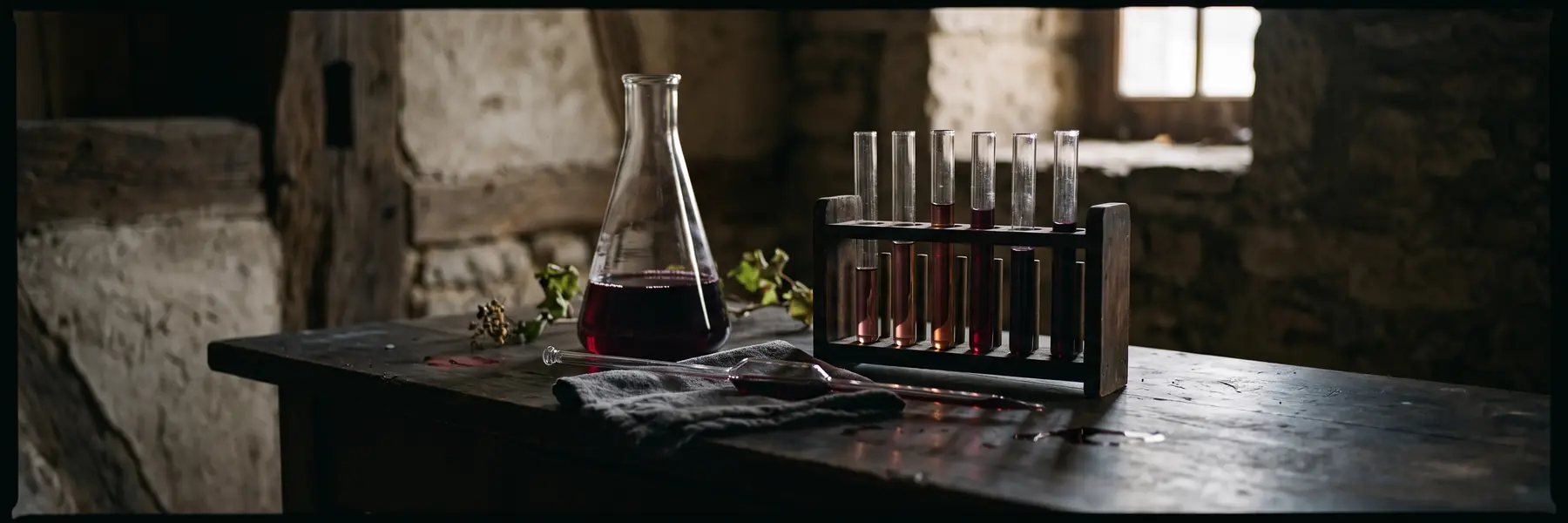
pH and TA: The Winemaker's Most Important Numbers
pH and TA: The Winemaker's Most Important Numbers
Acidity in wine is measured two ways — pH and titratable acidity (TA). Beginners often assume these measure the same thing. They don't. Understanding the difference between them — and why both matter — is fundamental to making balanced, stable wine.
pH: Acid Strength
pH measures the concentration of hydrogen ions in a solution on a logarithmic scale from 0 to 14. Lower pH = more acidic. Wine sits between 2.8 and 4.2 for most purposes.
pH is logarithmic: a change of one full unit — say from pH 4.0 to 3.0 — represents a 10× increase in hydrogen ion concentration, so even the smaller 0.5-unit drop from pH 3.5 to 3.0 is roughly a 3× jump (10^0.5 ≈ 3.16×). This means small changes in pH have outsized effects on wine chemistry.
Why pH matters in winemaking
Microbial stability: Bacteria struggle to survive at low pH. Below pH 3.3, spoilage bacteria find it very difficult to grow. Above pH 3.8, the wine is genuinely vulnerable.
SO₂ effectiveness: The molecular SO₂ fraction — the only genuinely antimicrobial form — depends on pH. At pH 3.2, approximately 3.8% of free SO₂ is in the molecular form. At pH 3.8, only 0.95%. This means high-pH wines need much more total SO₂ to achieve the same protection.
Colour: In red wines, anthocyanin colour exists in different forms depending on pH. Lower pH favours the red ionised form; higher pH shifts colour towards blue-purple and eventually brown.
Taste: pH correlates with perceived acidity but is not the only determinant — TA matters too.
TA: Acid Quantity
Titratable acidity measures the total concentration of all acids in the wine — not their strength, but how much of them there is. It's measured in g/L of tartaric acid equivalent, by titration (adding base until all acids are neutralised).
The main acids in wine and their contributions to TA:
- Tartaric acid: metabolically stable, doesn't change after harvest. The primary structural acid.
- Malic acid: sharp, green apple. Decreases with ripening and during MLF.
- Lactic acid: softer, milky. Produced during MLF.
- Citric acid: in small amounts naturally; also used for sanitisation. Can be metabolised by LAB.
- Acetic acid: volatile — see the volatile acidity article.
Why TA matters
TA is what you taste as sourness on the palate — the mouthfeel of acidity. A wine with TA 9 g/L will feel sharp and tart; one at 4 g/L will feel flat and soft.
Target TA:
- White wines: 6.5–8.5 g/L
- Red wines: 5.5–7.5 g/L
- Sparkling base: 8–10 g/L
- Dessert wines: 5–8 g/L (sweetness compensates)
Why pH and TA Can Disagree
This is where it gets interesting. A wine can have:
- High pH and high TA: sounds contradictory but happens when potassium content is very high. Potassium from the grapes acts as a buffer — it neutralises some acid hydrogen ions (raising pH) without removing the acid molecules (TA stays the same).
- Low pH and moderate TA: common in very acidic musts with low potassium. The acid is strong (aggressive pH) but not necessarily abundant.
Example: A Chardonnay from a very warm vintage might show pH 3.75 and TA 6.2 g/L. The high pH indicates poor microbial protection; the moderate TA says there's some acid there, but it's strongly buffered by potassium.
This scenario requires acidification with tartaric acid — which lowers pH because tartaric acid doesn't buffer as strongly as the organic salts that were providing the high potassium buffering.
Measuring pH and TA
pH
Use a calibrated digital pH meter. Calibrate with fresh buffer solutions (pH 4.0 and pH 7.0 are standard) before each measurement session. Temperature affects pH readings — measure samples at 20°C or apply temperature correction. Rinse the probe with distilled water between samples.
Paper pH strips are inadequate for winemaking — the colour resolution is insufficient for the precision required.
TA (Titration method)
- Measure exactly 10mL of wine into a flask using a pipette
- Add 2–3 drops of phenolphthalein indicator (colourless in acid, pink in base)
- Fill a burette with 0.1N NaOH (sodium hydroxide)
- Add NaOH drop by drop, swirling, until the wine turns a persistent pale pink
- Note the volume of NaOH used (in mL): TA (g/L tartaric acid equivalent) = mL NaOH × 0.75
Phenolphthalein changes colour at pH 8.2 — you're neutralising all the acids, not just the strong ones.
Red wines are harder to read with phenolphthalein (red colour masks the colour change). Use a pH meter to detect the titration endpoint at pH 8.2 instead.
Adjusting pH and TA
Acidification (raising TA, lowering pH)
Add tartaric acid — it lowers pH more effectively than malic or citric acid at equivalent amounts because it's a stronger acid and doesn't buffer as much. 1g/L of tartaric acid added to wine with moderate potassium typically lowers pH by 0.07–0.15 units and raises TA by approximately 1 g/L.
Never add citric acid if the wine is at risk of MLF — LAB metabolise citric acid to acetic acid, raising volatile acidity.
Deacidification (raising pH, lowering TA)
- Potassium bicarbonate (KHCO₃): 1g/L lowers TA by approximately 1 g/L and raises pH. Selectively precipitates tartaric acid.
- MLF: Converts malic acid to lactic acid. Reduces TA (lactic is weaker than malic) and raises pH.
- Cold stabilisation: Precipitates potassium hydrogen tartrate, reducing TA slightly.
Making Decisions
The most important practical rule: always measure both pH and TA, and use both to make decisions. Neither alone tells the full story.
A wine at pH 3.4 with TA 5.5 g/L needs acid addition (it will taste flat despite adequate pH). A wine at pH 3.7 with TA 8 g/L has high acid but a buffering problem (potassium is high) — add tartaric acid specifically.
Tip: Log both pH and TA at every measurement point in MakeWine — crush, post-fermentation, post-MLF, and pre-bottling. The pattern across these measurements shows you how your wine's acid profile is evolving and what interventions, if any, are needed.