Saperavi — A Winemaker's Guide to Georgia's Great Red
Saperavi — A Winemaker's Guide to Georgia's Great Red
Saperavi's name means "dye" in Georgian, and it earns it. It is one of a tiny handful of Vitis vinifera varieties with red flesh as well as red skin — a true teinturier — which means colour is never something you have to work for. That single trait changes the whole winemaking approach, and it is why winemakers who treat Saperavi like Cabernet usually ruin it.
Variety Profile
- Origin: Georgia, centred on Kakheti in the east; grown across the former Soviet sphere and increasingly in cool-climate North America
- Colour: Teinturier — pigmented pulp, not just skin
- Ripening: Late
- Acidity: High, and retained at full ripeness — unusually for a variety that also accumulates sugar readily
- Tannin: Firm and abundant, from thick skins and a high pip-to-pulp ratio
- Winter hardiness: Good; a real advantage in continental climates with hard winters
- Aromas: Black cherry, damson, blackcurrant, dried herbs, walnut, violet; leather and bitter chocolate with age
Where It Grows
Georgia is home. The dry expressions come from Kakhetian appellations — Mukuzani for the cask-aged benchmark, Napareuli and Kvareli for its siblings — while Kindzmarauli and Akhasheni make the naturally semi-sweet style. Outside Georgia it is planted in Russia's Krasnodar region, in Azerbaijan, in Ukraine, and — most interestingly for anyone in a cold climate — in New York's Finger Lakes, where its winter hardiness and late ripening make it one of the few serious vinifera reds that survives the winters.
Why the Teinturier Trait Matters
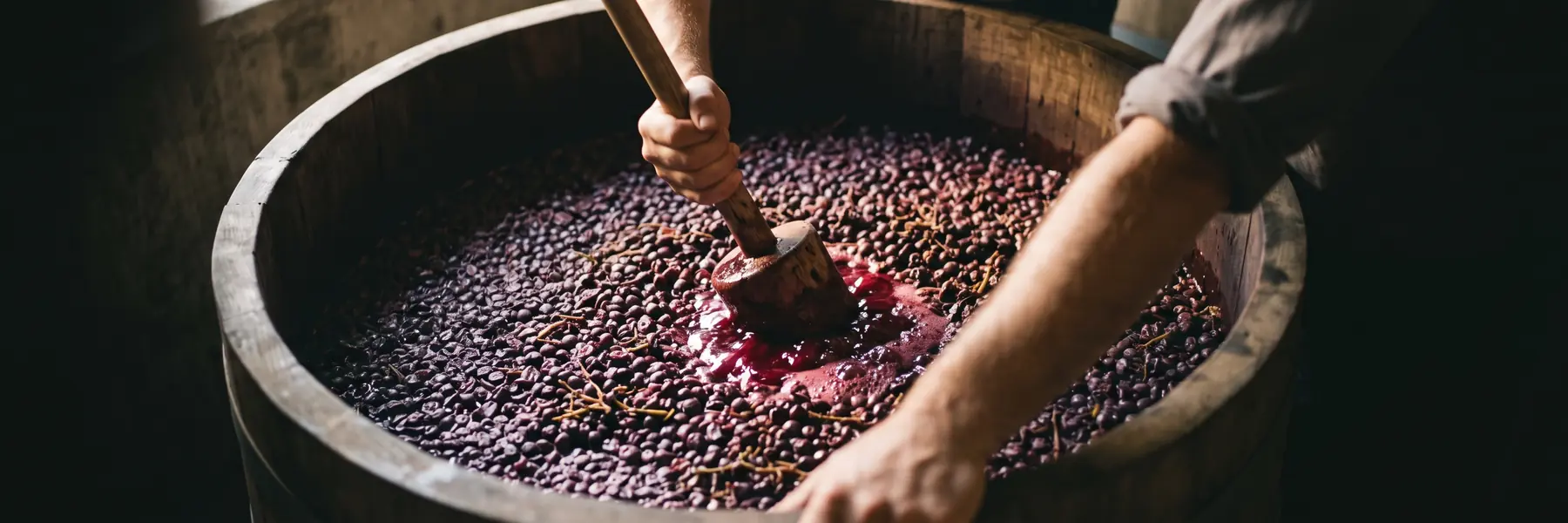
Almost every red-wine technique you have learned exists to get colour and tannin out of skins: long macerations, hot pre-ferment soaks, frequent punch-downs, extended post-ferment maceration. Saperavi hands you colour on day one.
That has a liberating consequence: you can macerate purely for tannin quality. You are no longer forced to keep the wine on skins for a fortnight to fill in a pale colour. So:
- A 7–10 day maceration with gentle, regular cap management usually gives a better wine than 18 days of hard work.
- Skip the hot pre-fermentation soak. You do not need it and it costs you freshness.
- Be careful with post-ferment extended maceration. Once alcohol is present, extraction shifts towards seed tannin, and Saperavi has plenty of seeds. Over-extracted Saperavi is bitter and hard, and time does not fix it.
Read tannin management and punch-down vs pump-over alongside this.
Harvest Targets
Saperavi's numbers look odd next to a Bordeaux variety, because it holds acid while sugar climbs.
| Parameter | Typical target |
|---|---|
| Brix | 23–26 °Bx |
| pH | 3.2–3.5 — genuinely lower than most ripe reds |
| TA | 6.5–9 g/L |
The temptation is to correct that acidity down. Usually, don't. Low pH means SO₂ is far more effective, colour is more stable, and the wine will keep for decades. Post-MLF the numbers will move anyway.
The real risk at harvest is not acid but seed ripeness. Because the wine is already dark and already sweet, it is easy to pick before the tannins are ready. Chew the pips: brown and nutty, not green and bitter. See harvest timing and reading grape chemistry.
Fermentation
Temperature: 24–28 °C. Saperavi does not need heat to give colour, so there is no reason to push into the 30s and lose aromatics.
Yeast: Anything with a good tolerance for low pH and a track record on structured reds. RC212 and BDX-type strains both work. What matters more is nutrition — Saperavi musts can be nitrogen-poor, and a stressed ferment on a low-pH must is where hydrogen sulphide problems begin. See choosing your yeast.
Cap management: Gentle. Two punch-downs a day, not four aggressive ones.
MLF, Ageing and Oak
MLF is essential. It is the single most effective tool for taking the edge off Saperavi's acid-plus-tannin combination without stripping the wine. Run it warm and to completion; a stalled MLF in a low-pH red is a long, frustrating problem. See MLF explained.
Oak: time, not toast. The traditional Georgian approach to serious dry Saperavi uses large, older casks, where the benefit is slow micro-oxygenation and tannin polymerisation rather than added flavour. Saperavi's aromatics are dark and savoury and a new 225 L barrel simply covers them with vanilla and coconut. If you have small barrels, use second- or third-fill wood. See barrel ageing basics.
Qvevri. If you have access to an amphora or clay vessel, Saperavi is the red it was designed for: buried clay gives stable temperature, gentle oxygen ingress and no wood character at all. The Kakheti guide covers the method.
Time. Saperavi at six months tastes hard and unresolved. At two to three years it comes together. At ten to twenty years good examples are still going. Judge accordingly.
The Semi-Sweet Route
Saperavi's acidity is what makes a semi-sweet red drinkable, which is why Georgia's sweet reds are made from it. If you go that way, the whole difficulty is arresting the ferment and then stabilising it safely — see Kindzmarauli for the process and back-sweetening for the stabilisation rules.
Blending
Saperavi is a generous blending component precisely because of the teinturier flesh: a small percentage will lift the colour and acid of a pale, flabby red without dominating its aromatics. If you grow both, keep a few percent of Saperavi back as a correction tool. See blending theory.
Food Pairing
Grilled and char-cooked lamb, pork and beef; walnut-thickened stews; mushrooms; aged sheep's cheese. Saperavi's acidity handles fat and its tannin handles smoke.
Tip: Split your first Saperavi in two and take one half off the skins at day 6 and the other at day 14. Taste them at three months and again at a year. Most winemakers who do this experiment never macerate Saperavi for a fortnight again.