Pinot Noir — A Winemaker's Guide to the Most Difficult Grape
Pinot Noir — A Winemaker's Guide to the Most Difficult Grape
Pinot Noir has a reputation for being difficult, and it deserves it. It is difficult in the vineyard, difficult in the cellar, and unforgiving in the glass — a wine with almost nowhere to hide. Every decision you take shows up in the bottle, which is exactly why it fascinates winemakers and why the best examples command prices no other red grape approaches.
The grape itself
Pinot Noir is ancient — old enough that it has thrown off a family of colour mutations (Pinot Gris, Pinot Blanc, Pinot Meunier) and old enough to be a parent of Chardonnay, which arose from a cross between Pinot and the now-obscure Gouais Blanc.
Physically it is a small, tightly packed bunch of thin-skinned berries. That description explains most of its problems:
- Thin skins mean low tannin, low pigment and vulnerability to splitting
- Tight bunches mean poor air circulation and high susceptibility to botrytis and other rots
- Early budburst means high spring frost risk
- Genetic instability means an unusually large number of distinct clones
It is also prone to millerandage (uneven berry set, giving a mixture of large and tiny berries in one bunch) and coulure (flower drop). Millerandage is often a quality advantage — the small seedless berries are highly concentrated — but it makes yields unpredictable.
Clones matter more than with most varieties
Because Pinot mutates readily, clonal selection is a genuine stylistic decision rather than a technicality:
- Dijon clones (a numbered series including 115, 667, 777 and 828) — smaller berries, more colour and structure; widely planted for quality
- Pommard and Wädenswil selections — the older North American workhorses; Pommard gives more structure, Wädenswil more red-fruited aromatics
- Older "heritage" or field selections in Burgundy and California often outperform anything catalogued
If you are planting, plant more than one clone and blend. A single-clone Pinot is usually narrower than a blend of three.
Where it grows well
Pinot Noir has a narrow climatic window: too cool and it is thin and stalky, too warm and it turns jammy and loses its perfume.
| Region | Character |
|---|---|
| Burgundy (Côte de Nuits, Côte de Beaune) | The benchmark; see our Burgundy guide, Gevrey-Chambertin and Chambolle-Musigny |
| Champagne | A principal grape of the blend, usually pressed to white; see the Champagne guide |
| Willamette Valley, Oregon | Burgundy's closest New World analogue; red fruit, earth, fine structure |
| Central Otago, New Zealand | Very high UV, dark-fruited, dense, more overtly powerful |
| Sonoma Coast / Russian River, California | Fog-cooled; riper, fuller, darker |
| Germany (Spätburgunder) | Baden and the Pfalz; increasingly excellent, elegant and light-framed |
| Alto Adige, Tasmania, Casablanca, Elgin | Cool sites producing serious, ageworthy Pinot |
Alsace, the Loire (Sancerre), Chile, Switzerland and England all make good Pinot too. What they have in common is coolness — usually from latitude, altitude, ocean or fog.
The central technical problem: colour
Pinot Noir contains far less anthocyanin than Cabernet or Syrah, and — critically — its anthocyanins lack the acylated forms found in most other red varieties. Acylated anthocyanins are more chemically stable. Pinot's are not, which is why:
- Pinot wine is naturally pale, and always will be
- It loses colour faster than other reds, browning at the rim within a few years
- Attempts to force more colour out of the skins mostly extract tannin instead
Accept this. The single most common mistake in home-made Pinot Noir is chasing colour and ending up with a wine that is still pale but now also bitter and coarse. Judge your Pinot by aroma and texture.
Harvest targets
Pinot ripens quickly and the window is short. Sample often and pick on flavour, using numbers to confirm:
| Parameter | Typical target |
|---|---|
| Brix | 22–24 °Bx |
| pH | 3.3–3.6 |
| TA | 5.5–7.5 g/L |
Above about 24.5 °Bx the perfume starts turning to stewed fruit and the alcohol becomes intrusive. Use the calculators to track potential alcohol, and see harvest timing for sampling method.
In the cellar
Cold soak
Two to five days at 8–12 °C before pitching yeast. Anthocyanins are water-soluble, so a pre-alcoholic maceration extracts colour and fruit without dissolving the harsher seed tannins. This is the best-value technique available for Pinot. Keep it protected with SO₂ or a CO₂ blanket.
Whole clusters
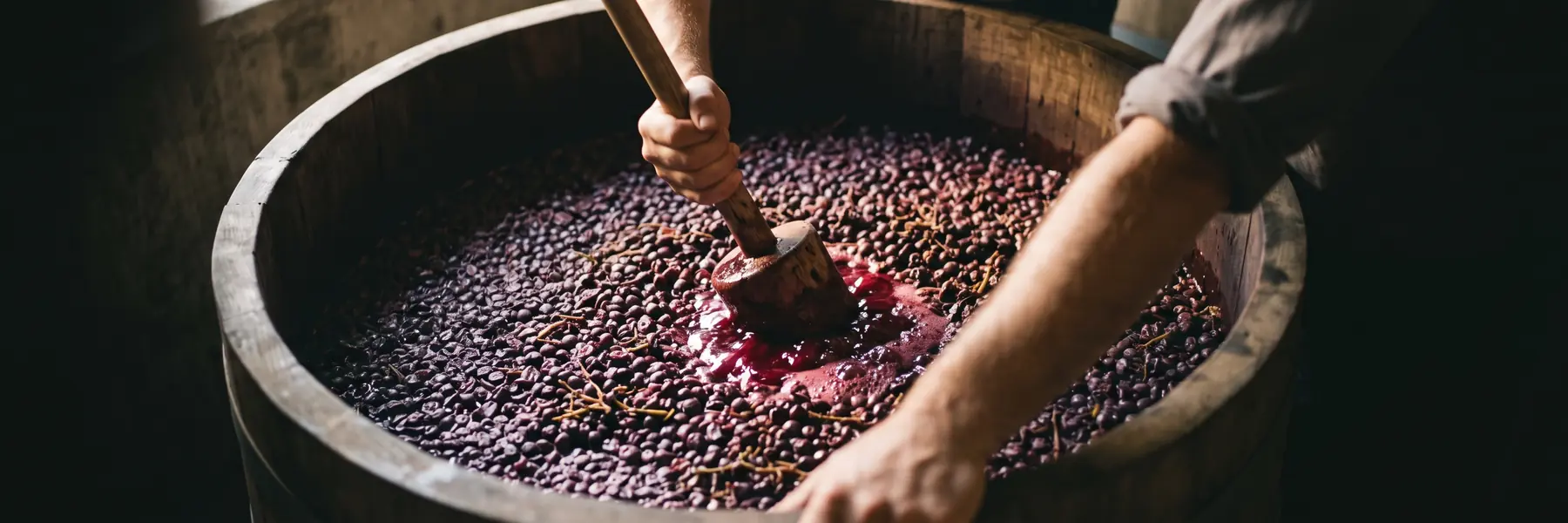
A proportion of whole bunches adds aromatic lift, a savoury spice note and structural frame. It requires lignified stems — brown, woody, snapping rather than bending. Green stems give greenness. Start at 20–30% with a destemmed control. See whole cluster fermentation.
Fermentation
Pinot needs a warmer peak than most reds to extract at all — up to around 30 °C is normal in Burgundy. But it also needs you to stop. Gentle punch-downs, two or three a day at peak, tapering off. Total time on skins usually 10–18 days. Taste the cap juice twice daily and press when the tannin turns from grippy to drying. See fermentation temperature and punch-down vs pump-over.
Yeast
RC212 (Bourgovin) is the classic Pinot strain — good colour stability and spice. D254 gives darker fruit and rounder tannin. Some producers use ambient/native ferments; see natural vs commercial yeast.
MLF
Always. Malic acid makes Pinot's already-firm acidity feel sharp. See MLF explained.
Oak
20–35% new French oak for a village-equivalent wine, higher only for genuinely concentrated fruit; 12–16 months. Larger vessels are safer than small ones with delicate wine. See barrel ageing basics.
Handle it as little as possible
Rack rarely, avoid pumps, skip filtration if the wine is clean, and don't over-sulphur. Pinot loses aromatics every time it is moved. See racking guide.
Common faults and their causes
| Problem | Usual cause |
|---|---|
| Thin, stalky, green | Underripe fruit, or green stems in a whole-cluster ferment |
| Jammy, alcoholic, no perfume | Picked too late |
| Bitter and drying | Over-extraction; too long on skins; hard press blended in |
| Tastes of oak, not fruit | Too high a new-oak proportion for the concentration |
| Browning at three years | Normal for Pinot — but accelerated by low SO₂ and oxygen ingress |
Food pairing
Duck, pigeon, mushrooms, salmon, roast chicken, truffle, and washed-rind cheeses like Époisses. Pinot is the most food-friendly red in the world precisely because of its low tannin and high acidity.
Tip: Buy a bottle of village-level red Burgundy and pour it next to your own Pinot before you decide anything about your winemaking. Almost every home winemaker who thinks their Pinot is "too pale" discovers that the benchmark is paler still.