Malbec — A Winemaker's Guide to Côt, Auxerrois and Argentina's Grape
Malbec — A Winemaker's Guide to Côt, Auxerrois and Argentina's Grape
Malbec is the great immigrant success story of the wine world. In France it was a supporting player and a regional speciality with a long, difficult history. Transplanted to the foot of the Andes, it became the identity of an entire wine industry. The two versions taste so different that many drinkers do not realise they are the same grape.
For a home winemaker it is one of the most rewarding red varieties available: generous with colour, generally clean and reliable in fermentation, and forgiving of imperfect technique — with a small number of specific weaknesses you need to know about.
Names and origins
Malbec is known as Côt in the Loire and the Lot, Auxerrois in Cahors (nothing to do with the Alsatian white grape of the same name), and occasionally Malbeck in older Argentine usage.
DNA work has identified its parentage as a cross between Prunelard and Magdeleine Noire des Charentes — the latter also being a parent of Merlot, which makes Malbec and Merlot half-siblings. Its origins are in south-west France.
Where it grows
Cahors, France
The historic homeland, on the terraces and limestone plateau of the Lot valley. The appellation requires a minimum of 70% Malbec, with Merlot and Tannat permitted for the balance. Cahors Malbec is darker, more tannic, more savoury and more austere than Argentine Malbec — the famous vin noir or "black wine". See our Cahors guide.
Bordeaux
Once significant, particularly on the Right Bank, and still a permitted variety. Its share collapsed after the devastating February 1956 frost, to which Malbec proved very vulnerable, and it was largely replaced by Merlot. It survives in small amounts in blends and remains more common in Bourg and Blaye.
Mendoza, Argentina
The variety was brought to Argentina in the 1850s, in the era of the French agronomist Michel Aimé Pouget, and it found conditions that suited it far better than its homeland: intense sunshine, very low humidity, negligible disease pressure, and — crucially — altitude.
The high-altitude vineyards of the Uco Valley and Luján de Cuyo, running from roughly 900 m to over 1,500 m, deliver a combination that barely exists elsewhere: full ripening from the intense high-UV sunlight, plus large diurnal temperature swings that preserve acidity and colour. That is why Argentine Malbec can be simultaneously plush, deeply coloured, floral and fresh. See our Argentina guide.
Elsewhere
Chile (both as a varietal and in blends), Cahors' neighbours in the south-west, Australia, Washington State, South Africa and California all grow it, usually in a New World, fruit-forward register.
Viticultural weaknesses
Three, and they are worth knowing:
- Coulure — poor fruit set. Malbec is notably susceptible, giving uneven bunches and unpredictable yields. Uneven ripening within a bunch is the practical consequence, and underripe berries in an otherwise ripe pick give a hard, herbaceous edge.
- Frost sensitivity — the 1956 lesson. Malbec buds relatively early and its wood is vulnerable.
- Downy mildew and rot in humid conditions — one reason it has thrived in arid Mendoza and struggled in maritime Bordeaux.
What the wine is like
Deep, opaque purple-black with a violet rim. Black plum, damson, blackberry, violet and, when very ripe, cocoa and sweet spice. Tannin is substantial but broad and soft-textured rather than sharp; acidity is moderate to low. Alcohol runs high in warm sites.
Cahors: more structure, more iron and graphite, drier and more savoury on the finish, ten to twenty years of life. Mendoza: plusher, more floral, sweeter-fruited, more immediately generous; high-altitude examples from good producers age fifteen years or more.
Making Malbec
Harvest targets
| Parameter | Typical target |
|---|---|
| Brix | 23–26 °Bx |
| pH | 3.5–3.8 |
| TA | 5.5–7.0 g/L |
Track potential alcohol with the calculators — ripe Malbec can move fast — and see harvest timing.
The pH problem
This is Malbec's main analytical hazard. It readily produces musts at pH 3.8 or above, particularly from warm sites, and high pH costs you three things at once:
- Colour stability — anthocyanins are redder and more stable at lower pH; at high pH the wine looks bluer and fades faster
- Microbial safety — a given free-SO₂ reading provides much less molecular SO₂ protection
- Freshness — the wine tastes flat and finishes short
Correct with tartaric acid at crush, before fermentation, where it integrates properly. See pH and TA and understanding SO₂.
Extraction: stop before you think you should
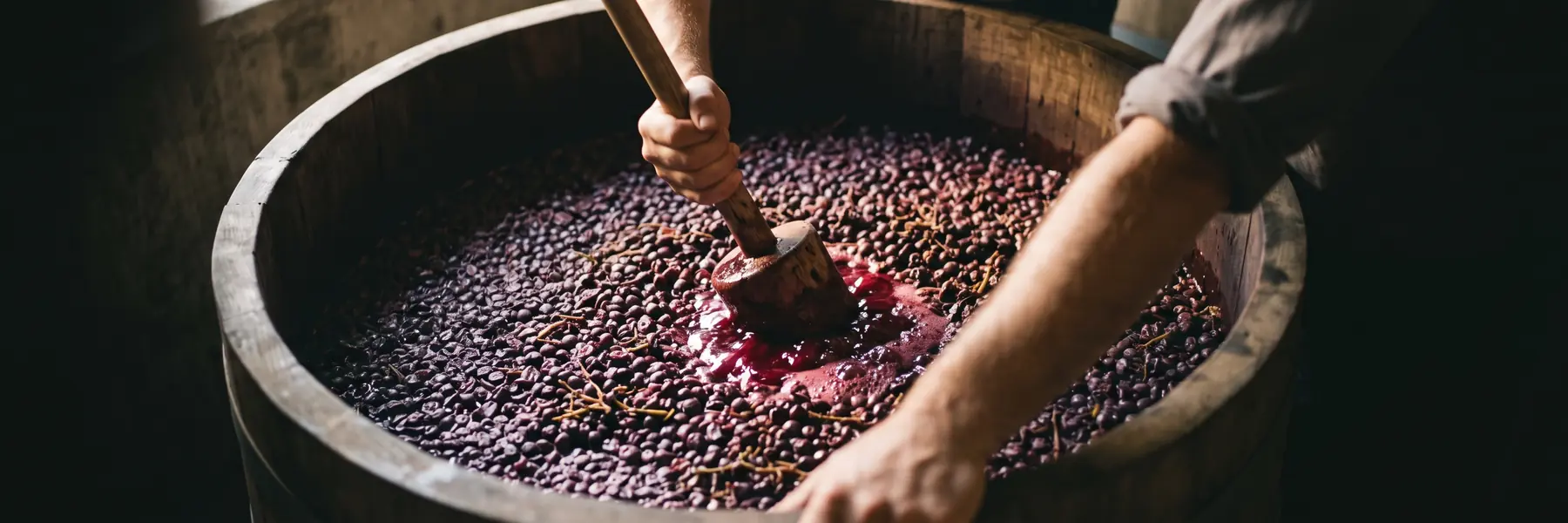
Malbec gives up colour easily and will look magnificent after four days. The temptation is to keep going, which pulls seed tannin and produces a wine that is black, bitter and hollow in the middle. Ferment at 25–28 °C, keep cap management moderate, and taste the juice daily. Ten to fourteen days on skins is plenty. See tannin management and punch-down vs pump-over.
Yeast
Strains selected for colour stability and dark fruit suit it — D254 and BM4x4 are common choices; RC212 works if you want more structure. See choosing your yeast.
MLF
Always. Pre-MLF Malbec tastes considerably harsher than the finished wine — do not judge it until MLF is complete. See MLF explained.
Oak
Malbec takes oak well. French oak, medium toast, 12–18 months gives the Cahors-leaning savoury profile. American oak pushes it toward the sweeter, vanilla-and-mocha Argentine commercial style. Both are legitimate; choose deliberately. Moderate the new-oak proportion to the concentration of the fruit. See barrel ageing basics.
Blending
The two classic corrections:
- Hollow mid-palate? Add 10–20% Merlot for flesh and weight — the Cahors solution.
- No finish, no structure? Add a small amount of Tannat, Cabernet Sauvignon or Cabernet Franc for a spine.
See blending theory and our Tannat guide.
Food pairing
Grilled beef above all — the Argentine asado pairing is not marketing, it works. Also lamb, duck confit, cassoulet, empanadas, hard cheeses, and anything with char on it.
Tip: Measure your Malbec's pH before you do anything else. It is the single number that most reliably predicts whether your finished wine will hold its colour and taste fresh in three years — and it is the easiest thing to fix at crush and the hardest to fix afterwards.