Tannat — A Winemaker's Guide to the World's Most Tannic Grape
Tannat — A Winemaker's Guide to the World's Most Tannic Grape
The name gives the game away. Tannat is, by most measures, the most tannic wine grape in commercial use — high in skin tannin, high in seed tannin, and unusually rich in the condensed tannins (procyanidins) that make a young red feel like sucking on a teabag. It is a grape that forced its growers to invent new technology in order to make it drinkable.
It is also genuinely worth making. Handled properly it produces dense, savoury, structured reds with real longevity, and it is a superb blending component for anything that lacks a backbone.
Where it comes from
Tannat's home is the far south-west of France, in the Pyrenean foothills:
- Madiran — the flagship appellation, in Gascony. Tannat-dominated, traditionally blended with Cabernet Franc, Cabernet Sauvignon and the local Fer Servadou (known here as Pinenc). Madiran was historically a wine of formidable, punishing tannin.
- Irouléguy — Basque country, on steep terraces in the western Pyrenees; a small appellation making Tannat-based reds and rosés
- Saint-Mont, Béarn and the wider Gascon south-west — Tannat appears widely in blends
- Cahors — permitted as a minor blending partner to Malbec; see our Cahors guide
Uruguay — Tannat's second homeland
Basque immigrants brought Tannat to Uruguay in the nineteenth century, and the variety is credited to Pascual Harriague, whose name became the local synonym for the grape — Uruguayan Tannat was long called Harriague.
Uruguay adopted it as its national variety, and it has good reason to. In Uruguay's warmer, more humid, Atlantic-influenced climate — mostly around Canelones near Montevideo, and in Rivera on the Brazilian border — Tannat ripens more fully and produces a noticeably softer, rounder, fruitier wine than Madiran. Still structured, but approachable at three to five years rather than fifteen.
The comparison is instructive: same grape, and the difference between the French and Uruguayan expressions is almost entirely about how completely the tannins ripen.
Tannat is also grown in Argentina, Brazil, and in small amounts in California, Virginia and Australia.
What the wine is like
Deep, dense, near-black. Blackberry, black plum, liquorice, tar, smoke, dried herb, and a distinct savoury, meaty depth. The tannin is the defining feature: firm, grippy, mouth-coating, and in young Madiran genuinely challenging. Acidity is moderate to high. Alcohol runs medium-high.
With time — and Madiran often needs a decade — the tannin resolves into something velvety and the wine turns savoury and complex.
Tannat's high procyanidin content has attracted a good deal of attention in nutritional research, and it is regularly cited as among the highest-polyphenol red wines. Treat any health claims with the scepticism they deserve; treat the tannin figure as a winemaking fact.
The invention that changed Tannat: micro-oxygenation
This is the single most interesting thing about the variety from a technical point of view.
In the early 1990s, the Madiran producer Patrick Ducournau developed a technique for introducing extremely small, controlled, continuous doses of oxygen into wine during and after fermentation — micro-oxygenation, or micro-bullage. He did it specifically to solve the Tannat problem.
The chemistry: controlled oxygen exposure promotes the polymerisation of tannins into longer chains, and encourages the formation of stable tannin–anthocyanin polymers. Longer-chain tannins are perceived as softer and less astringent, and the pigment complexes are more colour-stable. In effect, micro-oxygenation delivers a large part of the softening that would otherwise take years of barrel ageing.
The technique spread from Madiran across the entire wine world and is now used routinely on tannic varieties everywhere. Tannat is the reason it exists.
At home, you cannot dose oxygen at that precision — but you can achieve a coarser version of the same effect:
- Splash-rack rather than racking gently, once or twice during élevage
- Age in wood rather than glass; a barrel provides continuous slow oxygen ingress
- Give the wine a long élevage in bulk before bottling — see barrel ageing basics and racking guide
Be careful: uncontrolled oxygen exposure oxidises and can encourage acetic bacteria. Monitor free SO₂ and taste after each intervention. See understanding SO₂ and volatile acidity.
Making Tannat
Harvest targets
| Parameter | Typical target |
|---|---|
| Brix | 23–26 °Bx |
| pH | 3.4–3.7 |
| TA | 6.0–7.5 g/L |
The critical judgement is not sugar — it is tannin ripeness. Chew the skins and crack the seeds. If the pips are pale green and taste bitter and woody, the tannins are not ready and the wine will be aggressive no matter what you do. Ripe Tannat seeds are brown and taste nutty. See harvest timing.
Extract less than instinct suggests
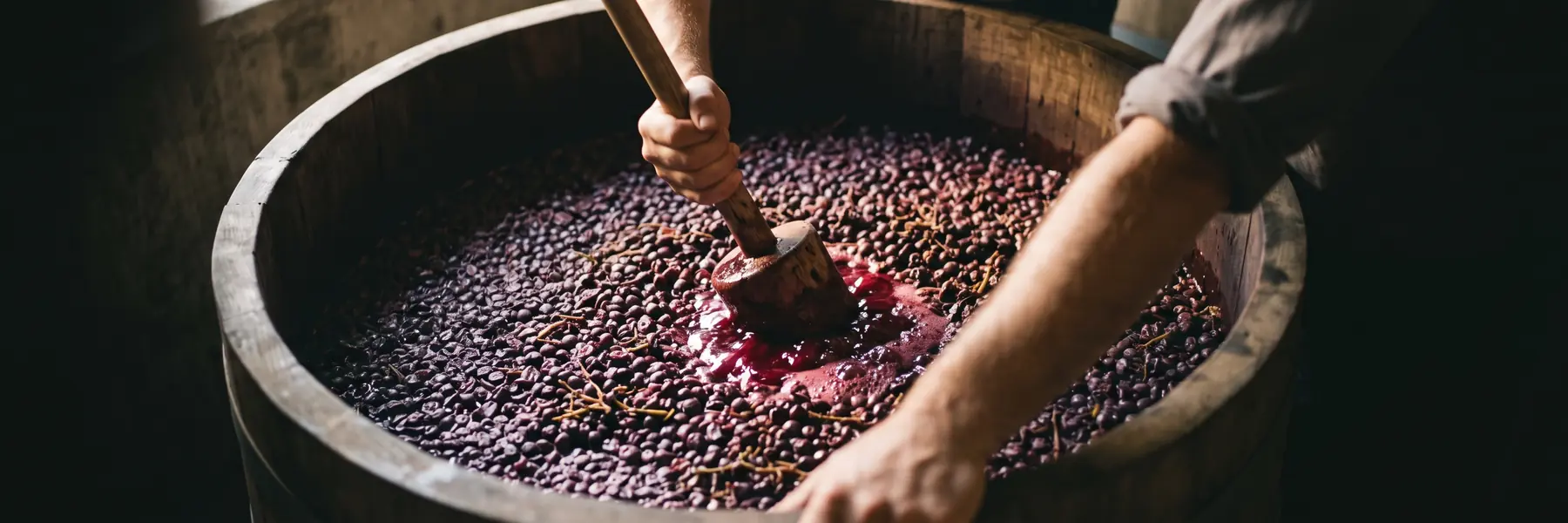
This is counter-intuitive with a dark grape, but Tannat needs no help. A shorter cuvaison — around a week to ten days — and gentle cap management gets you plenty of colour and structure. Long macerations and vigorous pumping over produce a wine nobody wants to drink. Press before the seed tannin comes out; keep the hard press fraction separate and taste it before you consider blending it back. See tannin management and punch-down vs pump-over.
MLF is essential
Malic acidity on top of that tannin is punishing. See MLF explained.
Blend it, the Madiran way
Cabernet Franc adds aromatic lift and finer tannin; Merlot adds flesh and softens the attack. A Tannat-dominant blend with 20–30% of something rounder is a far more drinkable wine than pure Tannat in most vintages. See blending theory.
Tannat as an additive
Turn it around: if you have a red that is soft, flabby and finishes nowhere, 5–10% Tannat will give it a spine and deepen its colour. It is one of the most effective structural blending components there is.
Fining, if needed
If the finished wine is still aggressively astringent, gelatin or egg-white fining removes harsh tannin selectively. Bench-trial it — over-fining strips body along with the tannin. See our fining agents article.
For another grape facing almost exactly the same problem, see Sagrantino di Montefalco in Umbria; for Tannat's French heartland alongside Malbec, see Cahors.
Food pairing
Duck confit and magret, cassoulet, garbure, grilled beef, wild boar, and strong hard cheeses. In both Gascony and Uruguay, Tannat is a wine made for fat, salt and protein — and it genuinely needs them.
Tip: With Tannat, taste your press fractions like a hawk. The gap between free-run and hard press is wider in Tannat than in almost any other variety, and blending the hard press back in "because it's only 5%" is how a good Tannat becomes an undrinkable one.