Cahors — The Black Wine and Malbec's Original Home
Cahors — The Black Wine and Malbec's Original Home
Long before anyone had planted a vine in Mendoza, Cahors was famous for a red so dark it was known simply as the black wine — vin noir — and it was shipped down the Lot and the Garonne to Bordeaux, where it was widely used to give thin claret colour and body. Cahors, not Argentina, is where Malbec comes from. It is also the appellation that Argentina's success has almost completely eclipsed, which makes it one of the better-value serious reds in France.
Geography
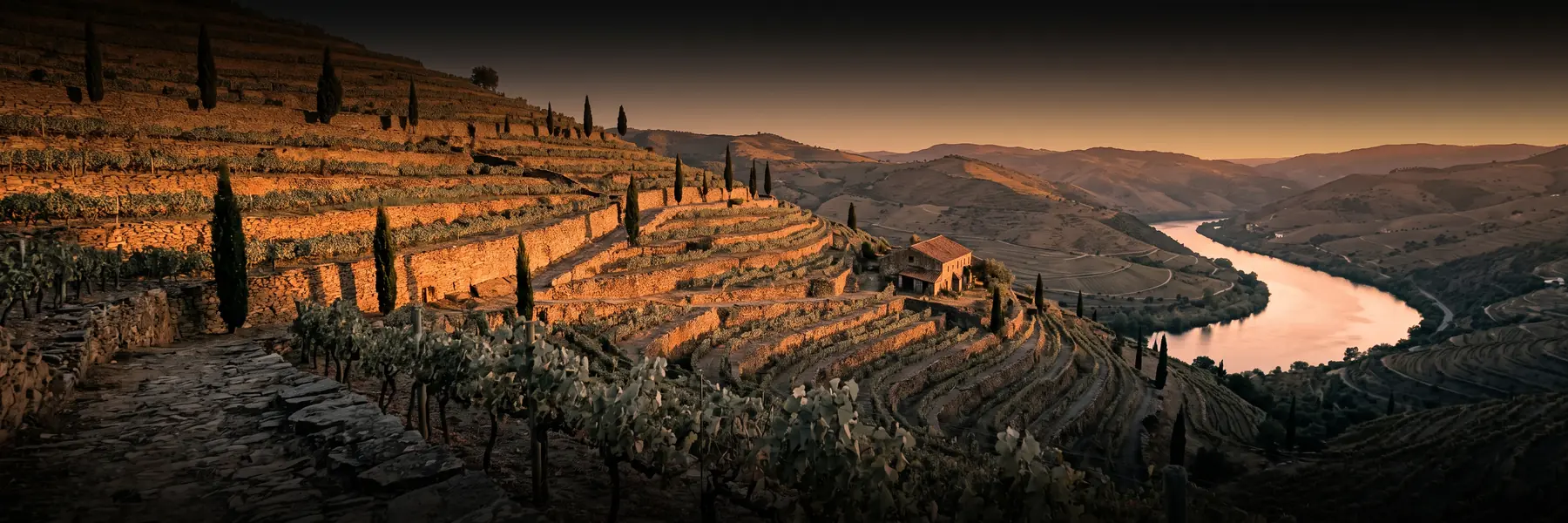
Cahors lies in the south-west of France, well inland, along the valley of the Lot river as it meanders west of the town of Cahors (downstream, toward its confluence with the Garonne). There are two broad terroir types:
- The river terraces — successive gravel and alluvial benches above the Lot. The lower terraces are warmer and more fertile and give rounder, fruitier, earlier-drinking wine.
- The causse — the high limestone plateau above the valley, thin-soiled, stony, cooler and later-ripening. The causse gives the appellation's most structured, mineral and long-lived wines, and the best estates increasingly emphasise it.
Knowing which a wine comes from tells you a great deal about how it will taste.
The grapes
The appellation requires a minimum of 70% Malbec — known locally as Côt, and historically as Auxerrois in this part of France. The balance, if any, is Merlot and Tannat.
Merlot softens and fleshes out. Tannat, from further south-west, adds tannin and colour and pushes the wine in a firmer, more austere direction. Many of the best modern Cahors are effectively 100% Malbec.
Climate
Continental with some oceanic influence — this is a good deal cooler and wetter than the Mediterranean south, with real vintage variation and disease pressure. Malbec here ripens later and less completely than in high-altitude Mendoza, which is precisely why Cahors is fresher, more savoury and more tannic than Argentine Malbec.
Two historical blows shaped the modern appellation. Phylloxera devastated it in the late nineteenth century, and the catastrophic frost of February 1956 — which hit the whole of south-west France — destroyed much of what had been replanted. Cahors only received AOC status in 1971 and has spent the decades since rebuilding a reputation that had once been international.
Producers
- Château du Cèdre — the modern benchmark; the Le Cèdre cuvée is the appellation's most decorated wine
- Clos Triguedina — long-established; the "Probus" cuvée and its historically inspired vin noir style
- Château Lagrézette — high-profile, polished, oak-influenced
- Château de Haute-Serre, Domaine Cosse-Maisonneuve, Fabien Jouves — the quality range from classical to natural
Style
Deep opaque purple-black — the colour is not a marketing claim, it is the grape. Black plum, damson, blackberry, violet, and a savoury undertow of tobacco, iron, graphite and dried herb. The tannin is firm and the wine finishes dry and structured rather than sweet. Good Cahors from the causse runs ten to twenty years and needs at least five.
Set against Argentine Malbec, the difference is stark: Mendoza gives plush texture, violet perfume and sweet ripe fruit; Cahors gives structure, savour and a rocky, austere finish.
What Cahors teaches your winemaking
Malbec is a rewarding grape for a home winemaker — generous with colour, generally clean-fermenting, and forgiving of moderate technique. Its problems are specific.
Colour is free; balance is not
Malbec's anthocyanin content is high and it stains everything. You will get a dark wine with very little effort. The mistake is to keep extracting because extraction is going well — which pulls seed tannin and gives a wine that is black, bitter and hollow. Taste daily and press when the tannin is ripe, not when the colour peaks. See tannin management and punch-down vs pump-over.
Watch the acid
Malbec tends to moderate-to-low acidity and can produce a high-pH must, particularly from ripe fruit. High pH costs you colour stability (anthocyanins are more red and more stable at lower pH), microbiological safety, and freshness. Measure at crush and correct with tartaric acid then, not later. See pH and TA and the calculators.
The green edge is real
Malbec is prone to coulure — poor fruit set — which produces uneven ripening across a bunch, and underripe Malbec has a hard, stalky, herbaceous character. Sort at the sorting table rather than hoping the blend absorbs it.
Blend for texture, the Cahors way
If your Malbec is dark and firm but lacking mid-palate, Merlot at 10–20% is the traditional local answer. If it is soft and lacks a finish, a small Tannat or Cabernet addition gives it a spine. This is a real, useful lever — see blending theory.
Oak suits Malbec, in moderation
Malbec takes French oak well; its dark fruit and the wood's spice combine naturally. Twelve to eighteen months in medium-toast French barrels with a modest new-oak proportion is a good starting point. American oak pushes it toward the sweeter, more commercial Argentine style — a legitimate choice, but a choice. See barrel ageing basics.
MLF always
Malbec's tannin and any residual malic acid combine into harshness. Complete MLF before you judge the wine — young, pre-MLF Malbec tastes far more aggressive than the finished wine will. See MLF explained.
For the variety across the world see our Malbec guide; for Argentina's version, the Argentina guide; for Tannat, the Tannat guide.
Food pairing
Cassoulet, duck confit, magret de canard, lamb, and the local Rocamadour goat's cheese. Cahors is built for the rich, duck-heavy cooking of south-west France and it is not subtle about it.
Tip: If your Malbec is inky but tastes hollow in the middle, the answer is almost never more time on skins. Take a sample, add 15% of a fleshy Merlot lot, and taste. Cahors growers have been solving exactly this problem the same way for two hundred years.