Hermitage — One Granite Hill, France's Most Powerful Syrah
Hermitage — One Granite Hill, France's Most Powerful Syrah
Hermitage is not a district or a valley. It is one hill — a granite outcrop of roughly 130 hectares above the town of Tain-l'Hermitage, on the left bank of the Rhône, facing due south. In the eighteenth and nineteenth centuries it was one of the most expensive wines in the world, routinely used to strengthen the finest Bordeaux, and "Hermitaged" claret was a recognised category in the London trade.
Geography
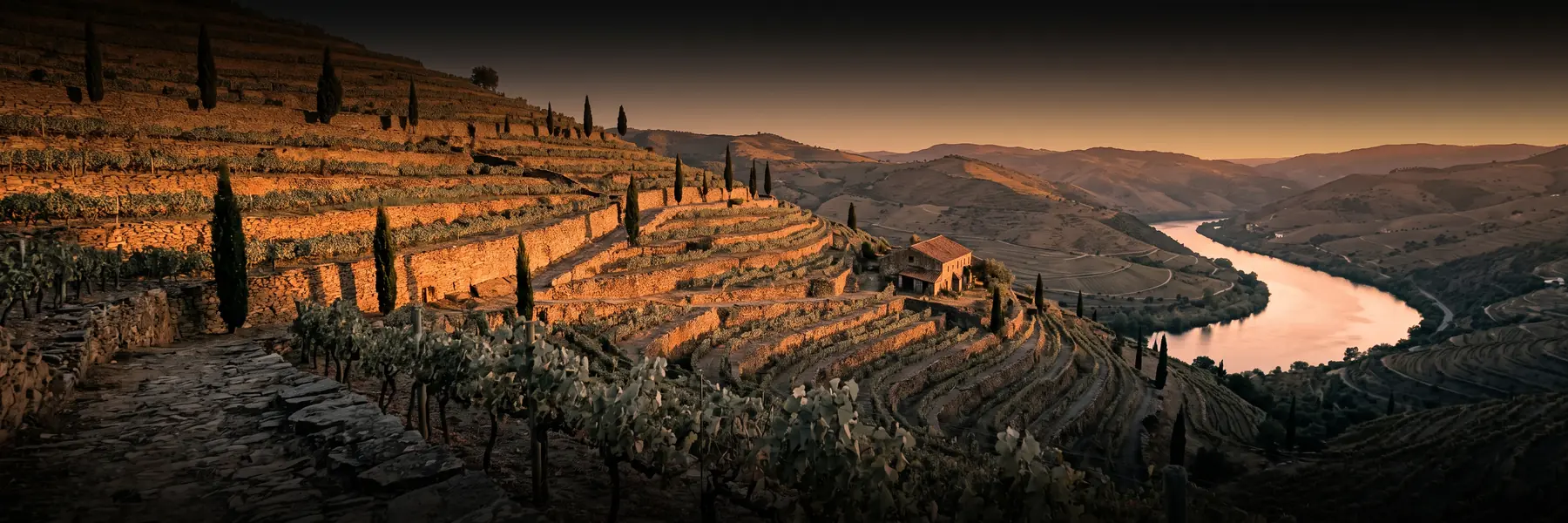
The Rhône makes a sharp turn at Tain, and the hill of Hermitage is the exposed granite shoulder left standing on the inside of that turn. Its full south-facing exposure at 45° north latitude is the reason Syrah can ripen fully this far from the Mediterranean.
The hill is not uniform, and its named lieux-dits have real, recognisable characters:
- Les Bessards — the western end, decomposed granite; the most tannic, structural and long-lived component
- Le Méal — central, with more stone and clay over granite; the most powerful and opulent
- L'Hermite — the top of the hill, beside the chapel; fine, mineral, aromatic
- Les Greffieux — lower slope, more clay; softer, perfumed, earlier-drinking
- Péléat and Les Rocoules — more clay and loess; Les Rocoules is prized for white
Almost all red Hermitage is a blend of lieux-dits, and knowing which parcels a producer owns tells you a great deal about their style.
The grapes
Red Hermitage is Syrah. The rules permit a small proportion of the white varieties Marsanne and Roussanne in the red, a historic practice, but most producers today bottle it as pure Syrah.
White Hermitage is Marsanne-dominated, usually with a little Roussanne. It is one of France's most underrated whites: broad, waxy, with honeysuckle and almond, low acid but astonishing longevity — it often goes through a dumb phase in its middle years and re-emerges at fifteen or twenty.
The hill also produces a vin de paille — grapes dried on straw mats to concentrate their sugar, then fermented to a sweet wine. It is made only in small quantities and only in suitable years.
Climate
Continental, moderated by the river and enormously amplified by the hill's exposure. The Mistral blows down the valley here as it does throughout the northern Rhône. Ripening is reliable on this hill in a way it is not in the surrounding countryside.
Producers
- Domaine Jean-Louis Chave — sixteen generations on the hill; blends across lieux-dits into what many consider the greatest Hermitage of the modern era
- Paul Jaboulet Aîné — La Chapelle, named for the small chapel at the summit; the 1961 is one of the legendary bottles of the twentieth century
- M. Chapoutier — the largest owner; single-parcel wines including Le Pavillon (Bessards) and L'Ermite
- Domaine Marc Sorrel and Domaine Bernard Faurie — smaller, traditional, excellent
Style
Red Hermitage is Syrah at its most concentrated: black fruit, olive, tar, iron, smoked meat, liquorice, with real tannic weight and a savoury mineral core. It is less floral than Côte-Rôtie and less wild than Cornas — denser and more complete than either. Young Hermitage is closed and brooding; it wants a decade minimum and can run forty years.
What Hermitage teaches your winemaking
Long élevage in neutral wood is a technique in its own right
Traditional Hermitage spends a long time in large old barrels before bottling. Time in a neutral vessel with slow, controlled oxygen exposure does something that time in bottle cannot: it lets harsh tannin polymerise into softer, longer chains, and it integrates the wine's components.
The practical version at home: if you have a serious, tannic red, give it longer in bulk than you think you need — 18 months rather than 9 — in a vessel that does not add flavour. Top up religiously and monitor SO₂, because a long élevage is also a long exposure. See barrel ageing basics and understanding SO₂.
Blending parcels is how consistency is achieved
Chave's method is to ferment each lieu-dit separately, then assemble. The Bessards lot supplies tannin, Le Méal supplies flesh, Les Greffieux supplies perfume. None of the three would make as good a wine alone.
Do the same with whatever variation you have — different rows, different vine ages, different pick dates. Small lots are inconvenient but they give you options, and options are what a blend is made of. See blending theory.
Marsanne is a lesson in low-acid whites
White Hermitage has naturally low acidity and high extract, and its makers do not fight that — they lean into texture, lees work and time instead of chasing freshness. If you have a low-acid white variety, this is the model: build weight and let the wine age rather than acidifying it into something it is not. Check your numbers first with pH and TA.
Vin de paille shows what drying does
Drying grapes concentrates sugar, acid and flavour together, which is why passito-style wines taste intense rather than merely sweet. If you want to try it, the Amarone guide covers appassimento technique and the hazards of fermenting a very high-sugar must.
For the wider region see the Rhône Valley guide; for the perfumed and the wild expressions of the same grape, Côte-Rôtie and Cornas.
Food pairing
Red: roast beef, venison, oxtail, hard mountain cheeses, anything cooked over wood. White: rich fish, veal, roast pork, and — at fifteen years — foie gras.
Tip: Hermitage is the strongest argument in wine for patience in bulk rather than patience in bottle. If a tannic red still feels aggressive after a year, do not bottle it and hope. Leave it in a topped-up neutral vessel for another six to twelve months and taste again — the change is usually greater than another two years in glass would deliver.