Côte-Rôtie — Syrah, Viognier, and the Art of Co-Fermentation
Côte-Rôtie — Syrah, Viognier, and the Art of Co-Fermentation
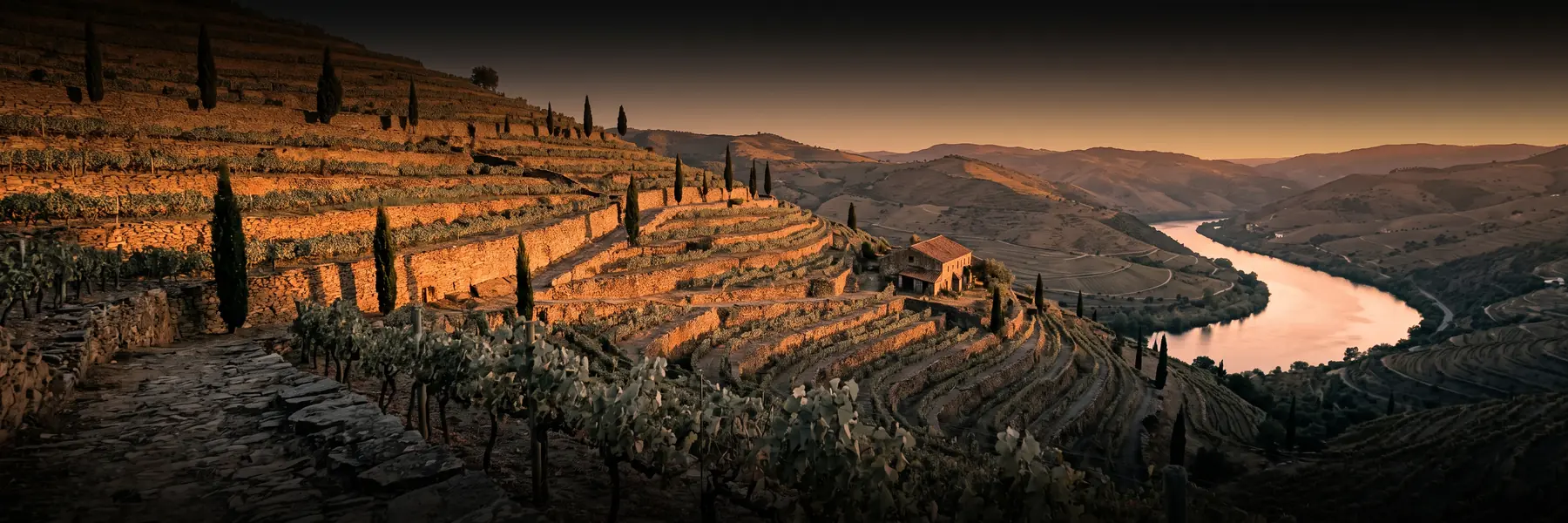
Côte-Rôtie means the roasted slope, and standing at the bottom of it in September you understand the name immediately: a wall of terraced vineyard rising almost vertically from the Rhône at Ampuis, facing south and south-east, catching everything the sun has. It is the northernmost appellation of the northern Rhône and it makes the most aromatic, most refined Syrah in France.
Geography
The vineyards climb granite and schist slopes so steep that terraces held by dry-stone walls — chaillées or murgeys — are the only way to farm them. Vines are trained low on tripods of chestnut stakes (échalas) rather than on wires, because a wire trellis would not survive the gradient or the wind. Everything is done by hand; a tractor cannot go there.
Two slopes define the appellation:
- Côte Brune — darker, iron-rich schist with clay. Produces the more structured, tannic, longer-lived wines.
- Côte Blonde — paler, lighter granitic-gneiss soils with more sand and mica. Produces more perfumed, softer, earlier-drinking wines.
The names are usually attributed to a local legend about a lord dividing the hill between his dark-haired and fair-haired daughters. The soil difference, however, is real and measurable, and traditional Côte-Rôtie was a blend of the two.
The grapes
Syrah is the base. Uniquely for a red appellation of this stature, up to 20% Viognier is permitted, and it is traditionally interplanted among the Syrah and picked and fermented together rather than blended afterwards. In practice most producers use far less than 20% — often a few per cent, sometimes none at all.
Climate
Continental, with the vineyard's south-facing aspect and heat-retaining stone doing the work that latitude does not. The Mistral blows here too, drying the vines and reducing disease pressure. Ripening is a genuine challenge in cool years — this is close to the northern limit for Syrah.
Producers
- E. Guigal — the dominant house; its three single-vineyard wines, La Mouline (Côte Blonde, with a notable Viognier component), La Landonne (Côte Brune, pure Syrah) and La Turque, are collectively known as the "La-Las" and are among the most collected wines in France
- René Rostaing — precise, transparent, terroir-focused
- Domaine Jamet — a blend across many parcels; classic, savoury, superb
- Domaine Clusel-Roch, Yves Cuilleron, Pierre-Jean Villa — the modern strength of the appellation
- Château d'Ampuis — Guigal's estate cuvée, a blend of seven Côte-Rôtie parcels
Style
Côte-Rôtie is the perfumed face of Syrah: violets, black olive, white pepper, bacon fat, raspberry and, with age, leather and smoked meat. Medium-bodied by northern Rhône standards, more aromatic than Hermitage, and far more elegant than most New World Syrah. Good bottles run fifteen to twenty-five years.
What Côte-Rôtie teaches your winemaking
Co-fermentation is real chemistry, not romance
This is the appellation's great technical lesson. Fermenting a small proportion of white grapes with the red — rather than blending the finished wines — changes the outcome measurably.
The mechanism is co-pigmentation. Anthocyanins (the red pigments) form loose complexes with colourless phenolic co-factors, including flavonols that white grape skins supply in quantity. Those complexes are more intensely coloured and more stable than free anthocyanin. A Syrah co-fermented with a little Viognier is typically deeper and more purple in youth than the same Syrah fermented alone — despite having been diluted with white juice.
The aromatic effect is separate: Viognier's apricot and blossom character carries through, adding a floral top note that pure Syrah does not have.
To try it: add 5–10% Viognier — or any aromatic white you have — to the crushed Syrah at the start of fermentation, skins and all. Ferment the two together as one lot. Run a control batch of straight Syrah alongside it. The comparison is one of the most satisfying experiments available to a home winemaker.
Whole clusters suit a perfumed Syrah
Syrah stems, when properly lignified, add lift and a peppery savour that fits the Côte-Rôtie style. Many producers here use a meaningful whole-bunch proportion. See whole cluster fermentation.
Don't over-extract a wine you want to smell
Syrah gives colour and tannin freely. In an aromatic style, moderate extraction — gentler cap work, a shorter cuvaison than you would give a Cabernet — protects the perfume. See punch-down vs pump-over and tannin management.
Syrah's pepper is a real compound, and heat destroys it
The black-pepper note in cool-climate Syrah comes from rotundone, a sesquiterpene that accumulates in cooler ripening conditions and is lost in very ripe, hot-grown fruit. If you want peppery Syrah, pick earlier and manage vineyard exposure; you cannot add it in the cellar.
Neutral or lightly used oak
Guigal's La-Las are famous for a high proportion of new oak, but they have exceptional concentration to carry it. For most fruit, used barrels or larger vessels over 12–18 months will frame the wine rather than smother it. See barrel ageing basics.
For the wider region see the Rhône Valley guide; for the powerful pole of northern Rhône Syrah, Hermitage and Cornas; for Viognier on its own, Condrieu.
Food pairing
Roast duck, game birds, lamb with olives, charcuterie, mushroom dishes, and — because of the bacon-fat note — anything smoked.
Tip: If you can get any aromatic white grape at the same time as your Syrah, co-ferment 5% of it and keep a control. Even at home scale the colour difference is usually visible in the glass, and it is a far more interesting result than adding an oak spiral.