Xinomavro — A Winemaker's Guide to Greece's Nebbiolo
Xinomavro — A Winemaker's Guide to Greece's Nebbiolo
The name translates as "acid black", which is two-thirds accurate: Xinomavro is emphatically acid, and emphatically not black. It is one of the world's great awkward grapes — enormous tannin, searing acidity, complex savoury aromatics, and a colour so pale and so unstable that inexperienced drinkers routinely assume the wine is faulty. Learn to work with it and you will understand red winemaking better, because Xinomavro forces you to separate three things most winemakers conflate: colour, tannin and body.
Variety Profile
- Origin: Northern Greece — Macedonia and Thessaly. Barely planted anywhere else
- Ripening: Late; needs a long autumn
- Acidity: Very high, retained at ripeness
- Tannin: Very high, firm, fine-grained
- Anthocyanin: Low, and what there is polymerises and fades quickly
- Bunches: Not especially loose; rot risk in a wet autumn is real
- Aromas: Sun-dried tomato, black olive, dried herbs, sour cherry, allspice; with age, leather, tobacco, dried fig, forest floor
- Ageing: Excellent — decades, in the traditional style
Where It Grows
- Naoussa — 100% Xinomavro; the benchmark, the most structured expression
- Amyndeon — higher and cooler at around 650 m, on sandier soils; lighter, more floral, and the appellation permits rosé and sparkling
- Goumenissa — blended with Negoska, a softer local red that fleshes it out
- Rapsani — on the slopes of Mount Olympus; blended with Krassato and Stavroto
The variety's response to altitude is unusually clear: cooler sites give perfume and finesse, warmer sites give flesh and colour. Neither gives a dark wine.
The Central Problem
Xinomavro presents the exact opposite balance to a Cabernet: it has more tannin than pigment. That has consequences you need to design around rather than fight.
Why the colour fades. Stable red wine colour depends on anthocyanin combining with tannin and other cofactors during and shortly after fermentation. With little anthocyanin to begin with, there is less to stabilise, so the free pigment that remains degrades and the wine turns brick-orange at the rim within a few years — regardless of how well it was made.
Why extraction makes it worse. The instinct on seeing a pale ferment is to macerate longer, work the cap harder, ferment warmer. Every one of those extracts more tannin from a variety that has too much already, and produces no pigment that was not present in the skins. The result is a wine that is still pale and now bitter.
What To Do Instead
Moderate maceration. A week to ten days, gently managed, then press. Extended post-fermentation maceration is rarely a good idea here. See tannin management and punch-down vs pump-over.
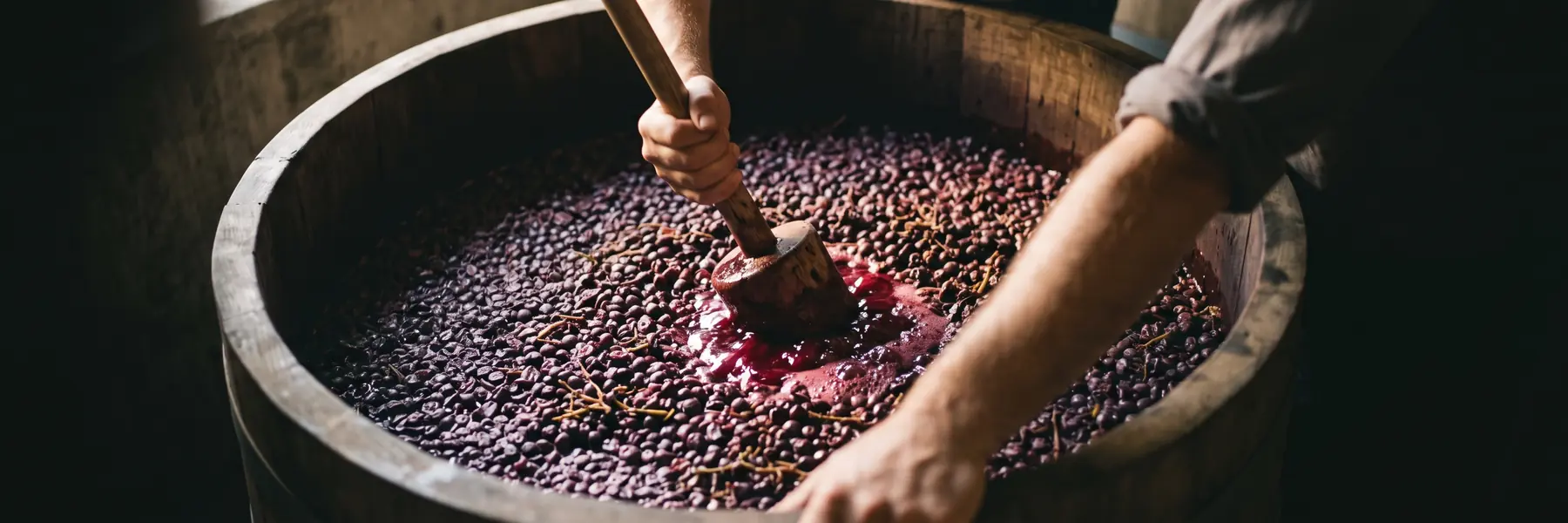
Allow some early oxygen. Pigment-tannin condensation reactions benefit from a small, controlled oxygen supply during and just after fermentation — which is precisely what open-top fermenters, punch-downs and a splashing first racking provide. This is the one point in a Xinomavro's life where oxygen is your friend, and it is why the traditional Naoussa method — open lagares, then large old wood — works.
Complete MLF, then age with slow micro-oxygenation. MLF is essential to soften a wine this acidic; at Xinomavro's low pH it can be slow, so warm the wine and use a low-pH-tolerant culture. Afterwards, large-format old oak gives slow oxygen ingress and tannin polymerisation without adding flavour. See MLF explained and barrel ageing basics.
Avoid new small barrels. A new 225 L barrel adds tannin to a wine with an excess of it, and vanilla and toast to aromatics that are savoury and delicate. Second-fill or larger is almost always better.
Do not fine the tannin away. It is tempting, and it strips the aromatics too. If you must reduce astringency, bench-trial first and use the mildest effective agent. Time in a large vessel does more.
Harvest Targets
| Parameter | Typical target |
|---|---|
| Brix | 22–25 °Bx |
| pH | 3.2–3.5 |
| TA | 6–8 g/L |
The real target is stem and seed ripeness, not sugar. Xinomavro at 24 °Bx with green seeds is a bitter wine; at 24 °Bx with brown, nutty seeds it is a fine one. Chew the pips. See harvest timing and reading grape chemistry, and use the calculators to plan where alcohol will land.
The Honest Alternatives
If you grow a low-colour, high-acid red — Xinomavro or anything else — three styles suit it far better than a struggling dark red, and Greek producers make all of them:
Rosé. Xinomavro's colour is a perfect rosé pigment load, and the acidity gives the wine tension most rosés lack. A few hours of skin contact, press, cool ferment, no MLF, bottle young.
Traditional-method sparkling. High-acid, low-alcohol base wine with modest colour is exactly what a bottle-fermented sparkling wine needs, which is why Amyndeon makes good ones. The method is set out in the Cava guide and the Champagne guide.
Light, early-drinking red. Whole-bunch or semi-carbonic, minimal extraction, no oak, bottled young — the approach that has won Xinomavro a new audience in the last decade. See whole cluster fermentation.
Blending
Xinomavro is one of the most improvable grapes in wine, and Greek tradition already tells you how: add a softer, fleshier, better-coloured partner. Negoska in Goumenissa, Krassato and Stavroto in Rapsani, Merlot or Syrah in modern PGI blends. Even 15% transforms the mid-palate. See blending theory.
Conversely, if you have a flabby, low-acid red, a small Xinomavro-style addition of any high-acid, high-tannin variety is a legitimate structural correction.
Food Pairing
Anything with cooked tomato — the aromatic match is genuine. Moussaka, pastitsio, lamb with tomato and cinnamon, stifado. Also hard sheep's cheeses, olives, cured meats, and with age, game and mushrooms.
Tip: Before you write off a pale, tannic young red, put it in a decanter for four hours and taste it again. Wines built like Xinomavro respond to air more dramatically than any other style, and the difference between the glass at pour and the glass at hour four will tell you whether you have a problem or just a young wine.