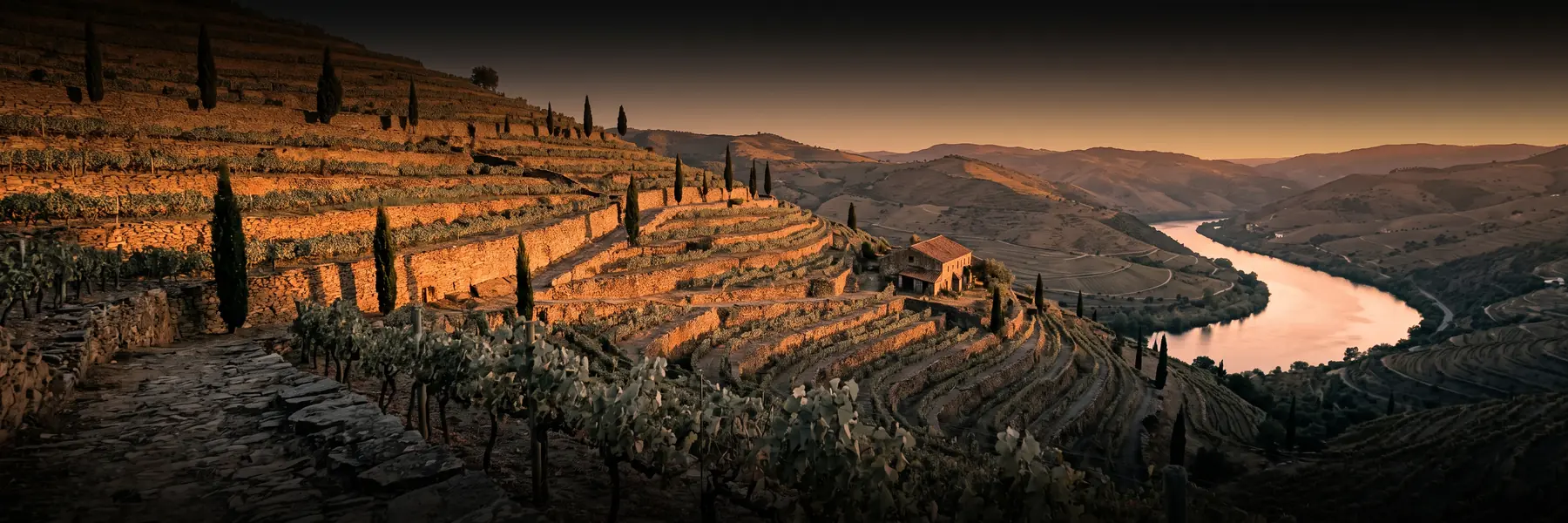
Pomerol — Merlot, Blue Clay, and the Appellation With No Classification
Pomerol — Merlot, Blue Clay, and the Appellation With No Classification
Pomerol has no château in the 1855 classification, no ranking of its own, no grand avenue of estates and barely a village centre. It is one of the smallest of Bordeaux's serious appellations, farmed largely by families working a few hectares each. It also contains Pétrus and Le Pin, two of the most expensive red wines on earth. Reputation here was built entirely by the market, bottle by bottle, without any official hierarchy to lean on.
Geography
Pomerol sits on the right bank of the Dordogne, immediately north-west of Saint-Émilion, on a low plateau. The interesting part is what is underneath.
The plateau is gravel and sand over clay, and at its highest point the clay comes close to the surface — the celebrated blue clay of the Pétrus vineyard, a dense smectite clay that swells when wet and holds water tenaciously. Beneath much of the appellation runs a layer of iron-rich hardpan the locals call crasse de fer, which restricts drainage and root depth.
The practical consequence: this is cool, water-retentive, slow-warming ground. Cabernet Sauvignon struggles to ripen on it. Merlot, which buds and ripens earlier and copes with clay, thrives — and clay gives Merlot a density and a silky texture it rarely achieves on gravel.
Climate
Maritime, marginally warmer and more sheltered than the Médoc across the estuary. Merlot's early ripening is both the appellation's advantage and its exposure: an early-flowering variety on a frost-prone plateau is vulnerable, and the catastrophic frost of February 1956 destroyed much of Pomerol's vineyard, forcing wholesale replanting.
The blend
Merlot dominates, typically well over two-thirds and at some estates effectively all of it. Cabernet Franc is the classic partner and is decisive at the estates that use it seriously. Cabernet Sauvignon appears only in small amounts, and mainly on the sandier, gravellier western edge.
| Variety | Role in Pomerol |
|---|---|
| Merlot | Plum, dark cherry, chocolate; fleshy mid-palate; the appellation's body |
| Cabernet Franc | Aromatic lift, fine tannin, structural backbone |
| Cabernet Sauvignon | Occasional seasoning on lighter soils |
Estates
- Château Pétrus — on the clay high point; essentially all Merlot; the wine that made Pomerol
- Le Pin — tiny production from a few hectares; the original "garagiste" phenomenon
- Château Lafleur — a high proportion of Cabernet Franc; many tasters' pick as the appellation's most complete wine
- Vieux Château Certan — the historic neighbour of Pétrus, more structured and Cabernet-influenced
- Château Trotanoy, Château L'Évangile, Château La Conseillante, Château Clinet — the depth behind the headline names
Style
Rich, round and immediately seductive: plum, black cherry, cocoa, violet, and with age truffle, iron and forest floor. The tannin is present but plush; Pomerol is one of the few great Bordeaux appellations you can enjoy at five years without feeling you have committed a crime. Good bottles nonetheless run twenty to thirty years.
What Pomerol teaches your winemaking
Merlot is the variety most home winemakers get wrong in the opposite direction to Cabernet. Cabernet is usually picked too early; Merlot is usually picked too late.
Merlot's ripening window is short
Merlot accumulates sugar fast and drops acid fast. Wait a week too long and you have 15% potential alcohol, a pH above 3.8, jammy fruit and no freshness — the "soupy Merlot" everyone complains about. Sample often and be prepared to pick on a specific day rather than a convenient weekend. Use harvest timing for the sampling discipline and the calculators to track potential alcohol as Brix climbs.
High pH is Merlot's real hazard
A high-pH must is microbiologically vulnerable, holds less molecular SO₂ for the same free-SO₂ reading, and produces a wine that tastes flat and browns early. If your Merlot comes in above pH 3.7, correct with tartaric acid at crush rather than after fermentation — it integrates far better. See pH and TA and understanding SO₂.
Extract less than you would for Cabernet
Merlot skins give colour and tannin readily, and over-extracted Merlot goes hard and hollow rather than powerful. A shorter cuvaison than you would give Cabernet — around a week to twelve days — and gentler cap management preserve the plush texture that is the whole point. See punch-down vs pump-over.
Cabernet Franc is the structural fix
If your Merlot tastes broad but shapeless, the Pomerol answer is not more oak — it is Cabernet Franc. Even 10–15% adds aromatic lift and a tannic edge that gives the wine a finish. Bench-trial it: blending theory.
Oak: quality over quantity
Merlot takes new oak well but its fruit is sweeter than Cabernet's, and vanillin on top of plum tips quickly into confection. Medium toast, 12–18 months, and a moderate new-oak proportion. See barrel ageing basics.
For the wider region see the Bordeaux guide; for the Left Bank's opposite approach to the same grape family, see Pauillac.
Food pairing
Duck, beef in red wine, mushroom and truffle dishes, roast pork, Époisses and other washed-rind cheeses. Mature Pomerol with truffle is one of the classic pairings of French cooking.
Tip: If you only have one lot of Merlot, split the pick. Take half at the point where the fruit is fresh and the acid still lively, take the rest a week later when it is fully ripe, ferment them separately, and blend. You get both freshness and flesh — and you learn exactly what that week costs you.