Vessel Types: Clay, Oak, Steel, Concrete and Glass
Vessel Types: Clay, Oak, Steel, Concrete and Glass
A vessel is not a neutral container. Every material you ferment or age wine in changes it, and the choice affects the wine continuously from the day you fill it to the day you empty it.
Strip away the romance and a vessel answers four practical questions:
- How much oxygen reaches the wine? The single biggest difference between materials.
- Does it contribute flavour, and does that change with use?
- How does it behave thermally — swinging with the cellar, or holding steady?
- What is the surface-area-to-volume ratio? A small vessel exposes far more wine per litre to its walls, and to whatever passes through them, than a large one of the same material. This is why a 25 L oak cask is not a scaled-down barrique, and why small-format anything is more aggressive than its large-format equivalent.
Cleanability, cost, weight and whether you can get it up your cellar stairs are the fifth question, and often the deciding one.
Stainless Steel
Inert, effectively airtight, easy to clean, available in every size. It contributes nothing and lets nothing in, which makes it the right default whenever the goal is to preserve exactly what the fruit gave you — aromatic whites, fresh rosés, fruit-forward reds.
Steel has almost no thermal mass, so it tracks cellar temperature closely: a liability in an uncontrolled space, an advantage if you have any cooling at all, because it responds quickly to whatever you do to it.
The characteristic reductive risk follows from the same virtue — with no oxygen ingress, a wine on lees in sealed steel can go reductive and stay that way. Rack, stir or splash deliberately rather than assuming the wine will sort itself out.
Oak
Oak does three things at once, worth separating.
Flavour extraction — lactones, vanillin, toast-derived compounds — is strongest in new wood and declines sharply with each use. A barrel that has held three or four wines contributes little flavour and is mostly acting as a slow-oxygen vessel.
Tannin contribution. Oak ellagitannins integrate slowly and help stabilise colour by interacting with anthocyanins. See tannin management.
Slow, continuous oxygen transfer through the staves and the bung. This is the part people underestimate: it polymerises tannins and softens structure in a way sealed vessels do not, and it is why an aged red in barrel evolves differently from the same wine in a glass demijohn.
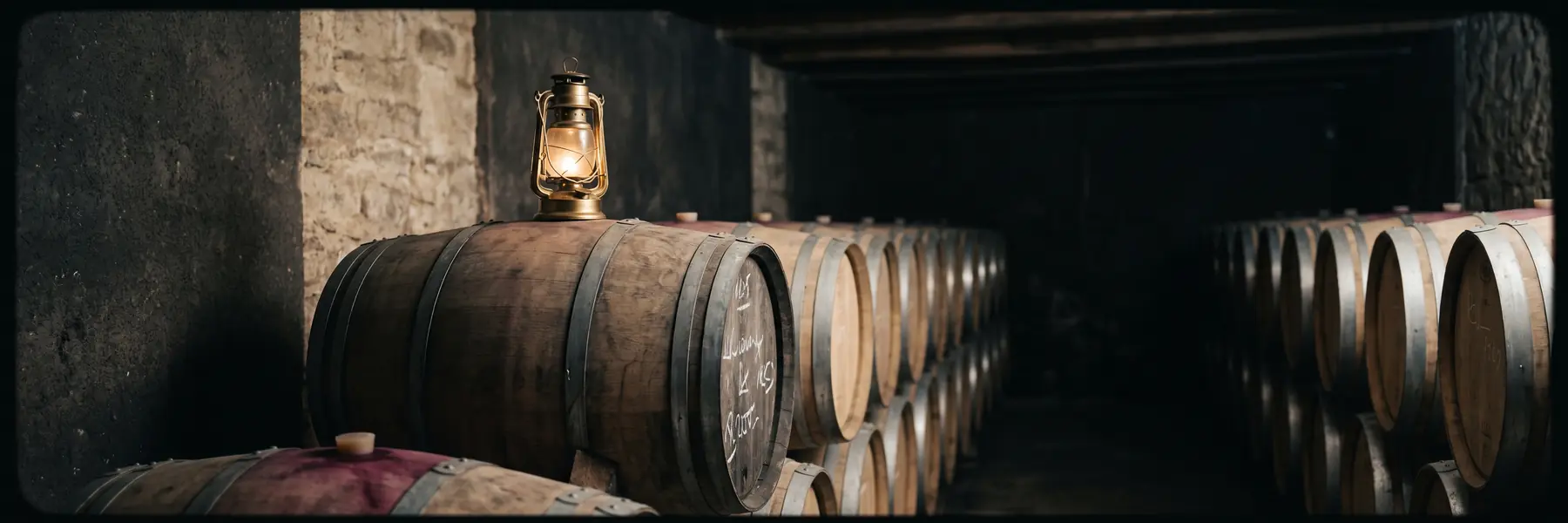
Format matters enormously. The Bordeaux barrique at 225 litres and the Burgundy pièce at 228 are the reference sizes; puncheons around 500 litres and larger foudres give progressively less oak character and slower oxygen transfer per litre. Very small casks are the opposite — high surface area, fast extraction, easy to over-oak — so for most home winemakers oak alternatives in a neutral vessel give more control than a small cask. See barrel ageing basics. Oak's real cost is maintenance rather than purchase price: barrels must be kept full and wet, and one that has dried out or gone microbially sour is very difficult to recover.
Clay: Karas, Qvevri, Amphora and Tinaja
Clay is the oldest wine vessel and, in Armenia and Georgia, a continuous living tradition rather than a revival. The Armenian karas and the Georgian qvevri are large earthenware vessels, traditionally buried or part-buried in the cellar floor; amphora and Spanish tinaja cover related shapes elsewhere. Sizes vary enormously by tradition and maker. What clay does:
- Oxygen transfer depends entirely on the clay body and the interior treatment. Unlined earthenware is porous and allows slow gas exchange, nearer oak's behaviour than steel's. Some traditions line the interior — beeswax is the classic qvevri treatment — which reduces porosity considerably. Modern amphorae are sometimes sealed with epoxy or fired to near-vitrification, at which point they behave much more like concrete. Two vessels both called "amphora" can behave completely differently, so ask the maker what the interior treatment is.
- No flavour contribution of the kind oak makes. Whatever character people attribute to clay wines comes from the oxygen regime, the shape, the extended skin contact these vessels are usually used for, and the thermal stability — not from the material tasting of anything.
- Excellent thermal stability, especially buried. A vessel in contact with the earth sits close to ground temperature and resists swings that would rattle a steel tank in the same room. For traditional winemaking without refrigeration, this is the practical point.
- Shape. The tapering base concentrates lees in a small area, part of why long lees contact in these vessels works as well as it does.
The honest difficulty is cleaning: a buried vessel with a narrow mouth and porous walls is hard to sanitise thoroughly, so clay is where sanitation discipline matters most — see sanitisation. Clay is also brittle and heavy, and a cracked karas is not repairable in any satisfying way. Its natural partner is extended skin contact — see skin-contact orange wine — and it is central to how wine is still made in Armenia and Kakheti.
Concrete
Concrete tanks and the fashionable "concrete egg" offer very high thermal mass — holding temperature steadily through a fermentation without cooling — and, when unlined, slight porosity giving a small amount of oxygen transfer. Epoxy-lined concrete is effectively inert.
The egg shape is often credited with setting up convection currents that keep lees in gentle suspension. Treat that as a claim rather than a settled fact: the thermal and oxygen behaviour is well understood, the fluid-dynamic story is disputed. Concrete needs curing and passivation before first use, and is heavy enough to be a structural decision.
Glass
Demijohns and carboys are the home winemaker's workhorse: cheap, inert, easy to inspect, sized for a small batch. Glass admits no oxygen through its walls, so all gas exchange happens at the surface and through the closure. Two real weaknesses — light, since clear glass exposes wine to light damage, so store in the dark; and fragility, particularly a full 25 L carboy, which is heavy, slippery and unforgiving.
Food-Grade Plastic
HDPE and PET fermenters are cheap, light and perfectly good for primary fermentation, but less suitable for long ageing: plastics allow slow continuous oxygen ingress, and surface scratches harbour microbes that survive cleaning. Ferment in plastic, age in glass, steel or wood, and replace scratched vessels rather than scrubbing them harder.
Choosing
| Goal | Reasonable choice |
|---|---|
| Preserve aromatics exactly | Stainless steel or glass |
| Soften a tannic red | Oak, or a neutral vessel with controlled oxygen |
| Add oak flavour | New or once-used oak, or oak alternatives |
| Slow oxygen without oak flavour | Neutral oak, unlined clay, unlined concrete |
| Temperature stability without cooling | Buried clay or concrete |
| Small batches on a budget | Glass, with plastic for primary |
Tip: Whatever the material, the vessel must be full. Headspace is where oxidation and acetic bacteria do their work, and no material protects a half-empty vessel. Choose sizes that match the volumes you actually make, keep smaller vessels for topping up, and check ullage every time you visit the cellar — see racking.