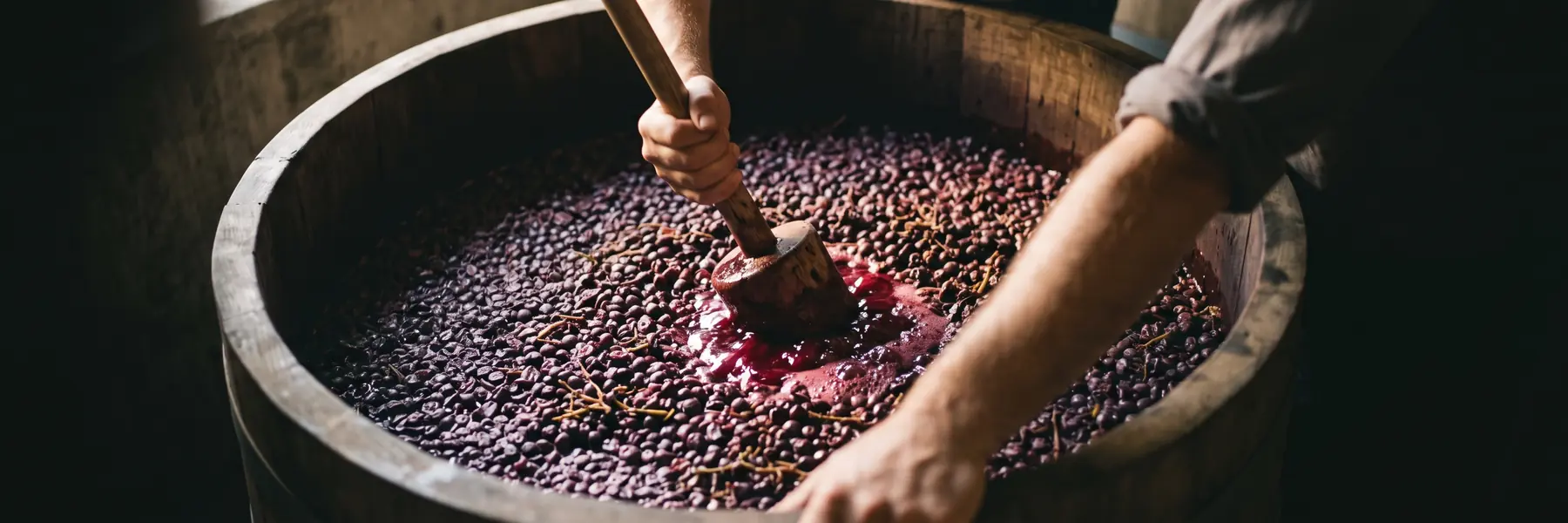
Press Fractions: Free Run, Light Press, and the Hard Cut
Press Fractions: Free Run, Light Press, and the Hard Cut
Pressing is the one operation that turns a single lot of fruit into several genuinely different wines. Juice that runs out under its own weight and juice squeezed from the last of the pomace are not variations on a theme — they differ in acidity, pH, phenolic content, solids and oxidative state. Blending them back together automatically throws away the best decision available to you. Keeping them apart costs a second vessel and a marker pen.
Free Run and Press Wine
Free run is the juice (whites) or wine (reds) that drains without pressure — from the crusher, from the drain valve of a tank, or from the press basket before the plate moves. It is the cleanest and gentlest material in the batch.
Press fractions are everything you extract afterwards, and they are not one thing. As pressure rises you recover liquid held in cells that had to be broken to release it, along with everything else those cells contained. Most winemakers distinguish at least a light press and a hard press; commercial white pressing often runs to more cuts, and Champagne's regulated distinction between the cuvée and the taille is the most famous formalisation of the idea.
How the Fractions Differ
The direction of travel is consistent across varieties and press types, even though the magnitudes are not:
| As pressure increases | Direction |
|---|---|
| Phenolics and tannin | Rise, often steeply |
| pH | Rises |
| Titratable acidity | Falls |
| Potassium | Rises |
| Solids and turbidity | Rise |
| Protein and nitrogen | Rise |
| Oxidation and browning | Increase (more surface, more time, more air) |
| Bitterness on the palate | Rises |
Two of these deserve emphasis. The pH rise with potassium is the reason a hard press fraction can taste flabby and be microbially vulnerable at the same time — see pH and TA, and the acid adjustment calculator if you decide to correct it. And the phenolic rise is where the bitterness lives: it is the whole argument for the hard press being a separate lot.
Whites: Where Bitterness Comes From
Thick-skinned, phenolic white varieties — Fiano, Greco, Verdejo, many Bulgarian whites — carry real grip in their skins. That grip is an asset when it is supportive and a defect when it is bitter, and pressing is where you decide which you get.
The free run and light press from these varieties are low in phenolics. The hard press is where the bitterness lives. So: press gently and slowly, take the free run separately before the plate moves at all, cut again as pressure rises, and taste and measure every fraction. Even two cuts is a large improvement on none.
Oxidation matters here too: white must has no tannin buffer, and the hard press fraction is both the most phenolic and the most exposed. Protect it promptly with SO₂ appropriate to its pH — see understanding SO₂.
Reds: Press Wine After the Ferment
For reds the timing is different. Fermentation happens on the skins, so you drain the finished (or nearly finished) wine off the cap as free run, then press the pomace.
Red press wine is typically more tannic, more coloured, higher in pH and coarser than the free run. On a moderate variety a modest proportion pressed back into the blend adds welcome structure. On a genuinely tannic variety — Nebbiolo, Tannat, Sagrantino, Cabernet from a warm site — the hard press cut can be punishing, and is often unusable as anything more than a minor component, if at all.
That is a blending decision, not an automatic inclusion. See tannin management for what you can and cannot do about tannin later, and whole-cluster fermentation if stems are in the mix, since stem tannin arrives in the press fraction too. Seed handling is part of this: aggressive pressing crushes seeds and releases harsh, low-molecular-weight seed tannin, and press hard enough for long enough and you will taste it.
Doing It at Home
Small-scale equipment makes fractioning easier, not harder — a basket press gives you complete control over when the pressure rises.
- Label three vessels before you start: free run, light press, hard press. Nobody labels accurately mid-press.
- Collect the free run in the first vessel and swap before applying pressure.
- Apply pressure in stages. Tighten, wait for flow to slow, tighten again. Swap vessels when what is running changes character — cloudier, darker and grippier are all cues.
- Record the volume of each fraction. Without volumes you cannot calculate a blend later.
- Protect each fraction immediately with SO₂ and, for whites, settle before racking off gross solids — see racking.
- Keep them separate through élevage if you can. Fractions aged separately give you far more to work with than a blend made on press day.
Tip: Volume matters more than most people expect. The press fractions are a substantial share of the total, and the exact split varies hugely with press type, how long the pomace drained, and how hard you were prepared to go. Weigh or measure rather than estimating — a "small addition" of hard press is only small if you know both volumes.
Judging the Cuts
Taste every fraction on its own first, then blind, then in trial blends. The method is the same one used for fining trials and general blending:
- Make up small measured blends at several percentages of press fraction — a handful of steps shows the shape of it.
- Always include the unblended free run as a control.
- Number the glasses and have someone else shuffle them.
- Assess bitterness and astringency on the finish, not the attack. Press-fraction bitterness shows up late.
- Let the trials sit for an hour and taste again. Some improve; some fall apart.
- Scale the winning ratio up arithmetically, and record both ratio and volumes.
What to Do With the Hard Press
Four honest options:
Blend a measured proportion back — the usual outcome when the fraction is sound and the wine wants more structure.
Keep it as its own wine. A separate small-batch bottling, honestly described, is often more interesting than a diluted compromise, and press-fraction lots can suit early drinking or a rustic style that carries the grip well.
Use it for topping up — practical, but only if it is clean and sound, and only in modest volumes relative to the vessel.
Discard it. Genuinely the right call sometimes, particularly for a bitter hard press from a phenolic white. A small volume of bad wine has ruined many larger volumes of good wine.
The wrong option is the fifth: tipping it in unmeasured on press day because it seemed a shame to waste it. That is not a blending decision, it is the absence of one — and it is irreversible.