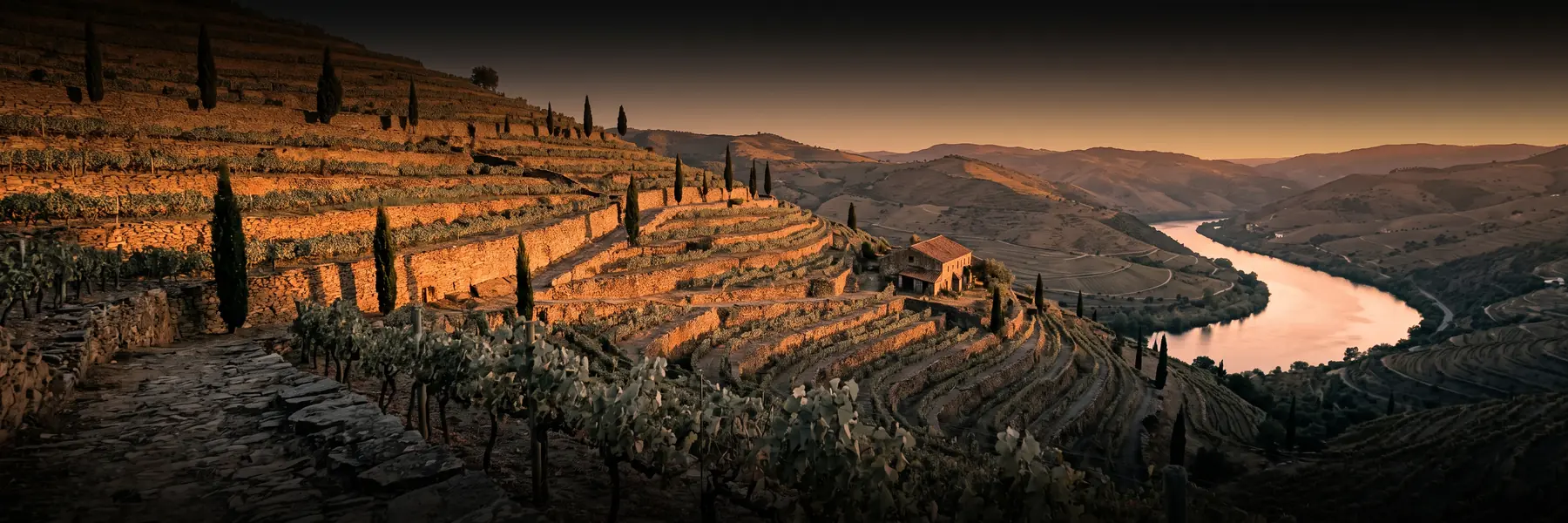
Nierstein and the Rote Hang — Riesling on Red Rock
Nierstein and the Rote Hang — Riesling on Red Rock
Drive south from Mainz along the Rhine and the riverbank suddenly turns red. The Roter Hang — the red slope — is a few kilometres of steep, rust-coloured hillside running from Nackenheim through Nierstein, and it is geologically unlike anything else in German wine. It also carries one of the most instructive reputational stories in Europe: a great vineyard whose name was legally handed to an ocean of cheap wine, and which has spent thirty years earning it back.
Geography
The Roter Hang lies in the northern Rheinhessen — Germany's largest wine region — on the west bank of the Rhine, immediately south of Mainz. The slope faces roughly east to south-east, dropping steeply to the river, which is unusual: most great German sites face south or south-west.
East-facing has a specific effect. The vines get the morning sun, warming quickly after a cool night, and are shaded from the fiercest late-afternoon heat. Combined with a soil that retains warmth, the site ripens reliably without cooking the fruit.
The Rock
The Roter Hang's soil is Rotliegend — red Permian slate and mudstone, laid down in a desert environment around 280 million years ago, coloured by iron oxide. Some sections are more clay-rich, some stonier.
The practical consequences differ from blue slate:
- Heat. A dark red soil absorbs and radiates heat strongly, which the east aspect needs
- Water. More clay content than Mosel slate, so better water retention — the vines are less drought-stressed
- Character. The wines are consistently described as spicier, earthier and more savoury than slate Rieslings, with a firmer, broader body and slightly lower acidity
Whether iron in the soil "causes" the spicy character is not settled science, and it is more honest to say that the site as a whole — rock, aspect, warmth, water-holding capacity — produces a recognisably different wine from the same variety.
The Sites
The classified vineyards on the Roter Hang are the reason to be here. In Nierstein: Pettenthal, Hipping, Ölberg, Orbel and the tiny Brudersberg. In Nackenheim to the north: Rothenberg. Pettenthal and Rothenberg are the steepest, reddest and most celebrated.
The Grosslage Story
German wine law of 1971 permitted Grosslage names formatted on labels exactly like individual vineyard names. Niersteiner Gutes Domtal became one of the most notorious: a collective name covering a very large area of mostly flat, high-yielding land well away from the red slope, sold in vast quantities as cheap semi-sweet export wine. Millions of bottles carried the word "Niersteiner", and almost none of them came from the Roter Hang.
The commercial logic was irresistible and the reputational damage was severe. Nierstein became a byword for cheap German wine at exactly the moment its best growers were making some of the finest Riesling in the country. Piesport on the Mosel suffered the identical fate via Piesporter Michelsberg.
The repair has come from two directions: a new generation of growers bottling single sites with the vineyard name unambiguously stated, and the VDP classification (Grosse Lage for the top sites) providing a signal that the legal system does not.
The lesson for any small producer building a name: a designation you do not control can be used to devalue it. It is an argument for putting the specific, verifiable facts of your own site on your own label.
The Grapes
| Grape | Character on the Roter Hang |
|---|---|
| Riesling | The main event. Spicy, earthy, stone-fruited, broader and less piercingly acidic than a Mosel Riesling; excellent dry as well as sweet |
| Weisser / Grauburgunder (Pinot Blanc / Gris) | The warm soil suits both; textured, nutty, food-friendly |
| Silvaner | An underrated Rheinhessen speciality; neutral, mineral, savoury |
| Spätburgunder (Pinot Noir) | Increasingly serious on the warmer sections |
Producers
- Kühling-Gillot — Nackenheim Rothenberg from ungrafted (wurzelecht) old vines; among Germany's finest dry Rieslings
- Gunderloch — Nackenheim; the historic reference for the Rothenberg
- St. Antony — Nierstein; strong across the classified sites
- Weingut Schätzel — Nierstein; low-intervention, long-lees, distinctive
- Georg Albrecht Schneider — reliable and good value from the Nierstein sites
What a Warm Site Does to Riesling — and How to Handle It
This is the useful part, because the Roter Hang's problems are the problems of any grower with Riesling in a warm site or a warming climate.
Acidity is lower, so the balance point moves. A Mosel Kabinett balances 8 g/L of residual sugar against ferocious malic acidity. On warmer soil the acid is lower, so the same residual sugar tastes sweeter and flatter. That is precisely why the Roter Hang's modern reputation is built on dry wine — trocken and Grosses Gewächs — rather than on the off-dry style. If your Riesling site is warm, make dry wine.
Alcohol arrives faster than flavour. Warm sites push sugar up before the aromatics fully develop. Track ripeness on flavour and acid rather than Brix alone; see harvest timing and reading grape chemistry, and plan the alcohol with the calculators.
Higher pH means more SO₂ for the same protection. A Riesling at pH 3.4 needs meaningfully more total SO₂ than one at 3.0 to achieve the same molecular protection. Do not carry a fixed dose across from a cooler site — read understanding SO₂ and pH and TA.
Still no MLF. Even at lower acidity, malic acid is structural in Riesling and converting it produces a soft, dull wine. See MLF explained.
Phenolic texture becomes the tool. With less acid to provide tension, body has to come from somewhere. Long lees contact, a slightly longer skin contact before pressing, and large neutral wood are all used on the Roter Hang, and they are the right instincts. See barrel ageing basics.
Ferment cool and protect the aromatics. 12–15 °C, an aromatic-preserving strain, minimal handling. See fermentation temperature. Our Germany Riesling guide and Rheingau guide cover the wider context.
Food Pairing
Dry Roter Hang Riesling: roast pork, Rheinhessen sausage, river fish, white asparagus, mushrooms — it has the body to handle richer food than a Mosel Riesling can. Grauburgunder with poultry and cream sauces. Older Riesling with hard cheese and smoked fish.
Tip: If your Riesling tastes broad and slightly flat, stop reaching for acid additions and try making the next batch bone dry instead. Dryness restores the sense of tension that low acidity takes away, and it is a decision that costs nothing.