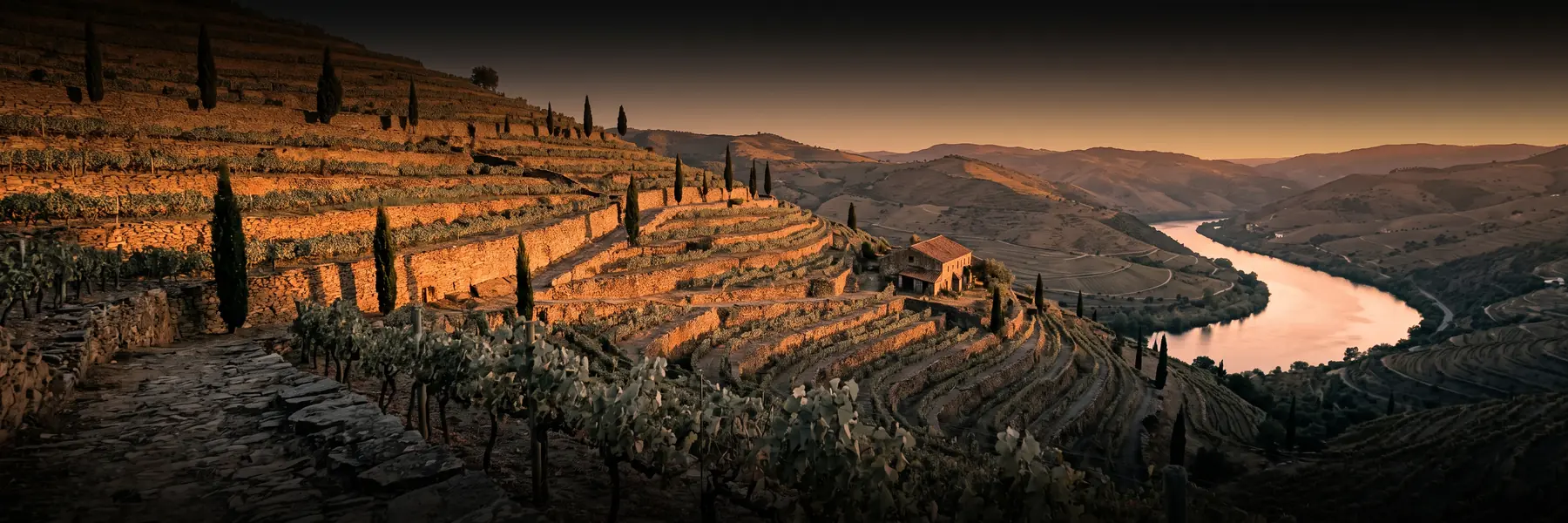
Dão — Granite, Altitude, and Portugal's Most Elegant Reds
Dão — Granite, Altitude, and Portugal's Most Elegant Reds
The Douro gets the attention, but plenty of Portuguese winemakers will tell you that the country's most finely structured reds come from the plateau to the south. Dão grows the same noble grapes as the Douro on completely different rock, at higher altitude, with cooler nights and more rain — and gets a wine with half the mass and twice the perfume. It is the best available demonstration that in Portugal, as anywhere, site does more than variety.
Geography
Dão is a granite plateau in central Portugal, at roughly 400–800 m, ringed by mountains that shelter it on every side:
- Serra da Estrela to the south-east — mainland Portugal's highest range
- Serra do Caramulo to the west — the barrier against Atlantic weather
- Serra da Nave and Serra de Montemuro to the north
Vineyards sit in a mosaic of clearings among pine and eucalyptus forest, on decomposed granite — sandy, acidic, low in nutrients, free-draining — with pockets of schist. It is poor soil, which is the point: vigour is naturally low and the vines struggle productively.
Climate
Continental, moderated by altitude and shelter. Cold winters with real frost, warm-to-hot dry summers, and — crucially — cold nights. The mountain rings block both the Atlantic's rain and the interior's extremes, giving a long, slow, even ripening season. Rainfall is reasonable, concentrated in winter.
The combination is unusual: enough warmth to ripen Touriga Nacional properly, enough night-time cooling to keep acidity and aromatics intact.
Key Grapes
Red
| Grape | Character in Dão |
|---|---|
| Touriga Nacional | Dão's calling card, and arguably better here than in the Douro: violets, dark cherry, bergamot, firm fine tannin, structured rather than massive |
| Jaen (Spain's Mencía) | Softer, juicier, earlier-drinking; red fruit and floral lift. See Bierzo for the same grape's other home |
| Alfrocheiro | Deep colour, blackberry and blueberry, good acidity; an excellent blender |
| Tinta Roriz (Tempranillo) | Structure, dark fruit, a savoury frame |
| Baga | Present in small amounts; the great grape of Bairrada next door |
White
| Grape | Character |
|---|---|
| Encruzado | Portugal's most serious white grape. Restrained citrus and stone fruit, high extract, low aromatics — and remarkable texture and ageing potential |
| Bical, Malvasia Fina, Cerceal | Blending whites; acid and freshness |
Wine Styles
Dão red: medium to deep ruby, not opaque. Violet, dark cherry, wild herbs, cedar and pine resin, mineral granite dust. Medium-bodied with fine, firm, well-defined tannin and genuine acidity. Alcohol typically 13–14%, restrained by Portuguese standards. The best examples close down for a few years and open beautifully at eight to fifteen.
The comparison people reach for is Burgundy or the northern Rhône rather than the Douro, and while that overstates it, the instinct is right: this is a wine of definition rather than density.
Encruzado: the discovery. Because it is not aromatic, it depends entirely on structure and texture — which means it takes barrel fermentation, lees work and time the way white Burgundy does, and repays them. Ten-year-old Encruzado is genuinely fine wine and almost nobody outside Portugal knows it exists.
Producers
- Quinta dos Roques / Quinta das Maias — the reference for varietal clarity; excellent Encruzado and single-variety reds
- Quinta da Pellada and Quinta de Saes — Álvaro Castro; old vines, restrained, benchmark Dão
- Casa da Passarella, Textura Wines — strong modern producers
- Sogrape (Quinta dos Carvalhais) — the large-scale quality reference
- Luís Pato and Filipa Pato — Bairrada-based, but their work with Portuguese varieties is essential context
What Dão Teaches: Altitude and Restraint
Diurnal range is a winemaking tool you cannot buy. Dão's cold nights are why the reds keep their acidity at full phenolic ripeness. If you have any choice of site, elevation and night-time cooling matter more than average temperature. If you do not, the equivalent cellar-side move is picking earlier than feels comfortable and accepting a leaner wine — see harvest timing.
Poor soil is good soil. Decomposed granite is nutritionally thin, which restrains vigour and concentrates fruit without any intervention. The corollary for a winemaker is a real one: musts from low-nutrient soils are often low in yeast-assimilable nitrogen, which means slow, stressed ferments and hydrogen sulphide if you do not feed them. Stage nutrient additions rather than adding everything at pitch. See choosing your yeast.
Touriga Nacional needs restraint. It is a small-berried, thick-skinned, deeply pigmented variety with abundant tannin — the classic profile for over-extraction. Ferment in the mid-20s °C, keep cap work gentle, and press before the tannin turns hard. Read tannin management and punch-down vs pump-over.
Oak should be invisible. Dão's aromatics — violet, bergamot, pine — are exactly what new small-barrel oak destroys. Large format, used barrels, or a modest new-wood fraction in a blend. See barrel ageing basics.
Non-aromatic whites are a different craft. Encruzado is the lesson: when a white has no obvious varietal perfume, everything depends on texture. Barrel fermentation, lees contact, partial MLF, longer élevage — the tools of white Burgundy rather than of aromatic-white production. See Chardonnay styles for the same problem in a better-known grape, and use the calculators to keep your acid and SO₂ numbers honest through a long élevage.
Food Pairing
Roast kid and lamb, chanfana (goat slow-cooked in wine), grilled pork, mushroom and chestnut dishes, Serra da Estrela sheep's cheese — one of Europe's great cheeses, from the mountains that shelter the vineyards. Encruzado with salt cod, roast chicken and shellfish rice.
Tip: If you make a red from a thick-skinned, deeply coloured variety and it keeps tasting bigger than you want, change one thing: press at or just before dryness instead of leaving it on skins afterwards. You will lose almost no colour and a great deal of hardness.