Douro Valley — Port Wine, Schist Terraces, and Portugal's Great River
Douro Valley — Port Wine, Schist Terraces, and Portugal's Great River
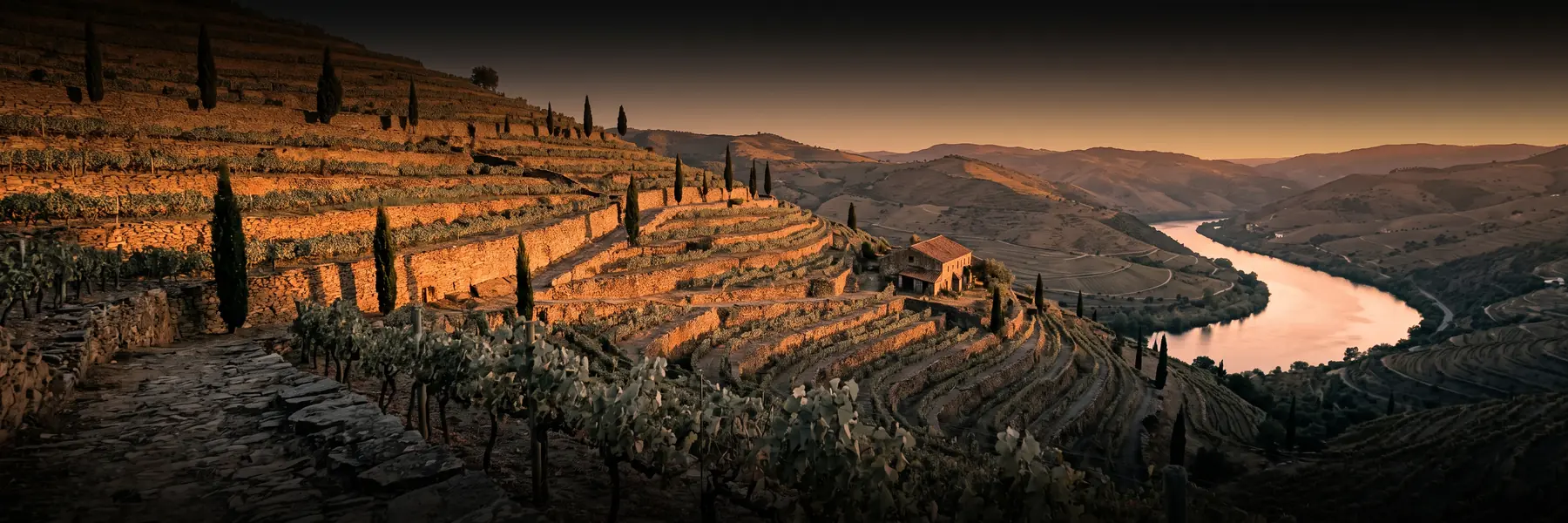
The Douro Valley is one of the world's most spectacular wine regions — carved by the Douro River through steep schist terraces, fiercely hot in summer, bitterly cold in winter. Home to Port, Portugal's most famous wine export, the Douro is also producing some of the country's most exciting dry table wines from the same ancient native grape varieties.
Geography
The Douro runs east from Porto (at the Atlantic coast) deep into the inhospitable interior of Portugal toward the Spanish border. Three sub-zones with distinct characters:
- Baixo Corgo — closest to Porto; most moderate climate; highest rainfall; lighter Ports; most table wines
- Cima Corgo — the heart of the Douro; hot, dry, continental climate; the best quintas are here; benchmark Port production
- Douro Superior — the furthest inland; most extreme heat and drought; highest alcohol; Barca Velha is produced here by Ferreira
The unique feature: schist soils. Hard, fractured slate-like rock that barely holds water, forcing vines to root 5–10m deep to access moisture. This deep root system produces concentrated fruit even in extreme summer heat.
Climate
Continental, intensified by the valley walls which concentrate heat. Summer temperatures regularly reach 40°C+. The Porto mountain range (Serra do Marão) blocks Atlantic humidity — the further east, the more extreme and arid. Winter temperatures drop below 0°C.
Key Grapes
The Douro has over 80 permitted native varieties. The most important:
Red
| Grape | Character |
|---|---|
| Touriga Nacional | Noble; dark fruit, floral violets, firm tannins; backbone of premium Port and table wine |
| Touriga Franca | Most planted; perfumed, elegant; reliable partner to Touriga Nacional |
| Tinta Roriz (Tempranillo) | Structure, dark fruit, spice; widely planted |
| Tinto Cão | Delicate; floral, fresh acidity; diminishing |
| Tinta Barroca | Plummy, soft, contributes colour and body |
| Tinta Amarela (Trincadeira) | Aromatics, freshness; better at altitude |
White
| Grape | Character |
|---|---|
| Rabigato | Crisp, citrus, mineral |
| Viosinho | Aromatic, peach |
| Gouveio | Rich, round |
| Códega | Neutral; high volume |
| Moscatel Galego | Aromatic; for Moscatel wines |
Port Wine
Port is a fortified wine produced by arresting fermentation with grape spirit (aguardente), leaving residual sugar balanced by the spirit. The result (typically 19–22% ABV, 80–120 g/L residual sugar) is rich, complex, and remarkably long-lived.
Port Styles
Ruby styles (tank-aged; fruit-forward):
- Ruby — basic; young, fresh, cherry-red; drink within 3–5 years of release
- Reserve Ruby — richer; selected lots; more concentration
- Late Bottled Vintage (LBV) — from a single year; bottled 4–6 years after harvest; filtered (most) or unfiltered (traditional LBV — needs decanting)
- Vintage Port — declared only in exceptional years; from best quintas; bottled after 2–3 years in barrel; must age 10–30+ years in bottle; the pinnacle of Port
Tawny styles (barrel-aged; oxidative):
- Tawny — basic; brief barrel time; sweet, nutty
- Colheita — single vintage Tawny; aged minimum 7 years; nutty, complex; must be consumed within 6 months of opening
- 10, 20, 30, 40-year Tawny — blend of different ages indicating average age; 20-year is the classic recommendation; dried fruit, walnut, orange peel
White Port: From white grapes; ranges from dry to sweet; often served chilled as aperitif with tonic.
How Port Is Made
- Grapes are crushed and fermentation begins (often in granite lagares where treading by foot is traditional).
- When approximately half the sugar is fermented (Brix drops to ~10°Bx), grape spirit is added.
- The alcohol kills the yeast, preserving residual sweetness.
- Wine is separated from skins; transferred to lodges in Vila Nova de Gaia (Porto) in spring.
- Aged in wood (pipes — 550L barrels) or bottles depending on style.
Douro Table Wines
Since the 1990s, unfortified Douro table wines have emerged as some of Portugal's most exciting. Made from the same varieties as Port, fermented to dryness:
Douro DOC Red: Rich, structured, aromatic. Dark fruit, violets, mineral, firm tannin. Very distinct from other European reds. The best rival top Rhône or Tuscany in complexity.
Key producers of table wines: Quinta do Crasto, Quinta do Vale Meão, Niepoort (Redoma is a benchmark), Ramos Pinto, Quinta do Vallado.
Douro Branco (White): Emerging star. Native white varieties produce complex, mineral, food-friendly whites — often more interesting than comparable price-point Portuguese whites.
Famous Port Houses
- Quinta do Noval — "Nacional" vineyard (ungrafted vines); legendary Vintage Port
- Graham's — Symington family; benchmark across all styles; "Six Grapes" Reserve is excellent
- Taylor Fladgate — consistently outstanding Vintage Port; also Fonseca and Croft
- Ramos Pinto — excellent quality-value; strong Tawny programme
- Niepoort — iconoclast producer; unfiltered LBV; superb Douro table wines (Redoma)
- Ferreira — "Barca Velha" is Portugal's most celebrated dry red wine
Making Port at Home
The principle of arresting fermentation with spirit can be applied at home:
- Start a red wine fermentation from high-sugar must (26–30°Bx target).
- Monitor SG carefully. When the gravity has dropped to approximately half the original sugar (i.e. 12–13°Bx remaining), be ready to fortify.
- Add food-grade grape spirit or brandy to achieve target ABV of 19–20%.
- Rule of thumb (Pearson square: spirit needed = desired rise ÷ (spirit strength − target ABV)): near a 19–20% target, each 1% of ABV needs roughly 1.3% v/v of 96% spirit, or about 1.7% v/v of traditional-strength (77%) aguardente.
- Separate from skins; press; age in small oak or glass demijohns.
Food Pairing
Ruby/Vintage Port: Stilton and blue cheese (the classic match), dark chocolate, walnut cake.
Tawny Port: crème brûlée, almond tart, aged hard cheeses, dried fruit.
Douro table red: roast lamb, migas (bread-based dishes), presunto (cured ham), grilled pork ribs.
White Port (chilled): aperitif, tapas, fried bacalhau.
Tip: Vintage Port is one of the world's longest-lived wines — but only if stored properly. Light and heat are the enemies. A well-stored Vintage Port from the 1970s can still be magnificent today. If you make your own fortified wine, give it at least 5 years before judging it.