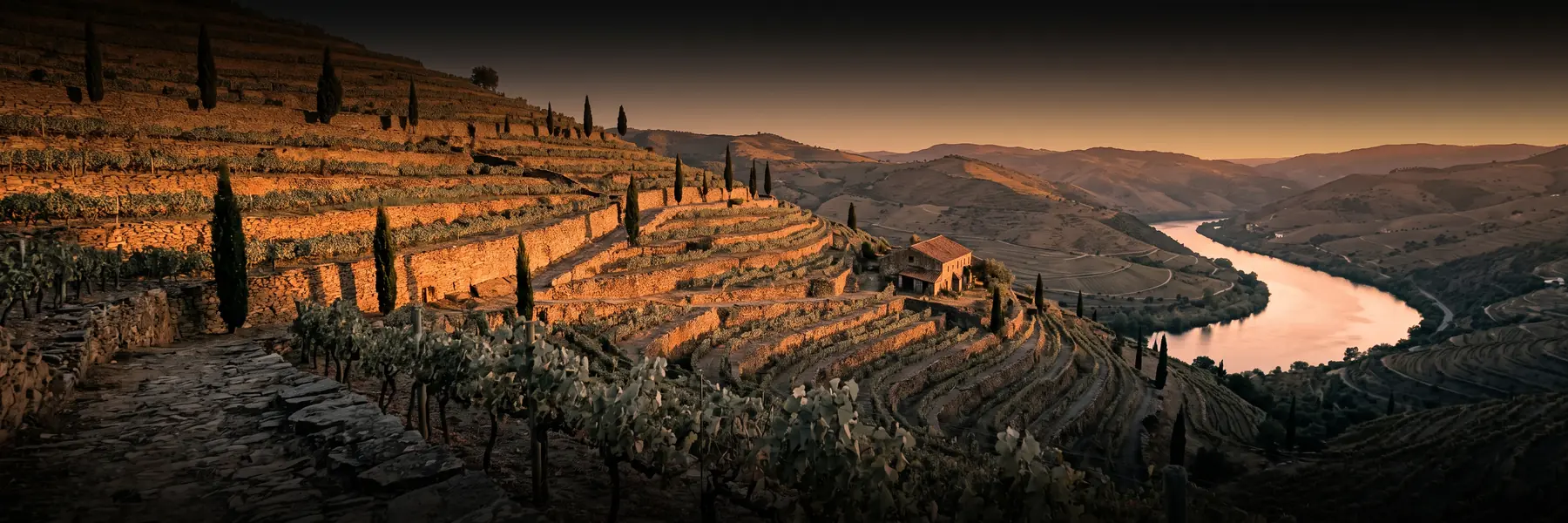
Brunello di Montalcino — Pure Sangiovese, Five Years' Wait
Brunello di Montalcino — Pure Sangiovese, Five Years' Wait
Brunello is the wine that proved Sangiovese could stand alone. Everywhere else in Tuscany the grape has traditionally been blended — with Canaiolo, with Colorino, latterly with Cabernet — because on its own it can be thin, drying and awkward. In Montalcino, from a particular clonal population on a particular hill, it makes one of the longest-lived reds in Europe with nothing added at all.
Geography
Montalcino is a hilltop town in southern Tuscany, about 40 km south of Siena, with the appellation occupying the hill and its slopes on all sides. Vineyards run from roughly 120 m to around 600 m, and the appellation's internal variation is largely a matter of altitude and aspect:
- The north, toward Torrenieri and Montosoli, is cooler, with more clay-limestone and galestro (a friable schistous marl). Wines are more perfumed, higher in acid, slower to open, more classically structured.
- The south, toward Sant'Angelo in Colle and Castelnuovo dell'Abate, is warmer and drier, with more sandy and rockier soils and the moderating influence of the Orcia valley. Wines are riper, fuller, more powerful and more approachable.
- The higher sites on the hill itself sit above much of the summer heat, and increasingly matter as the climate warms.
Monte Amiata, the extinct volcano to the south, casts a rain shadow over the zone, which makes Montalcino noticeably drier than Chianti Classico to the north. Drought, not rot, is the local hazard.
The rules
- 100% Sangiovese — no other variety is permitted. The local clonal population has long been called Brunello.
- Minimum two years in oak, plus a period in bottle, with the wine not released until 1 January of the fifth year after harvest. Riserva is released a year later.
- Rosso di Montalcino is the appellation's second wine: also 100% Sangiovese from the same zone, with a much shorter ageing requirement, released after about a year. It is the best-value serious Sangiovese in Tuscany and it exists for exactly the reason Bordeaux's second wines exist — somewhere for the lots that will not carry five years.
The Biondi-Santi story
Brunello's invention is credited to the Biondi-Santi family in the second half of the nineteenth century, and specifically to the decision to vinify Sangiovese alone and age it at length. The estate's 1888 and 1891 riserva bottlings became legendary, and Biondi-Santi's Tenuta Greppo remained the reference for the appellation for a century.
Brunellogate
In 2008 Italian authorities investigated allegations that some producers had blended unauthorised varieties into Brunello. Several estates had wine impounded and the scandal — inevitably nicknamed Brunellogate — did real damage to the appellation's standing. It also settled the question definitively: the consorzio held the line on 100% Sangiovese, and traceability and controls tightened considerably afterwards.
It is worth knowing as a piece of history, but also as a reminder that a rule about grape composition is only worth what the enforcement behind it is worth.
Producers
- Biondi-Santi — the founding estate; austere, classical, extremely long-lived
- Case Basse di Gianfranco Soldera — idiosyncratic, uncompromising, and among the most expensive wines in Italy
- Poggio di Sotto — the modern benchmark for the traditional style
- Il Poggione, Canalicchio di Sopra, Cerbaiona, Salvioni, Lisini — the depth of the appellation
- Casanova di Neri and Valdicava — richer, more modern in style
Style
Garnet, rarely deep. Sour cherry, dried plum, orange peel, tobacco leaf, leather, dried herbs and — with age — balsamic and earth. High acid, firm tannin, medium body. Young Brunello is austere and hard to enjoy; at twelve to twenty years it opens into remarkable savoury complexity, and great vintages run thirty or more.
What Brunello teaches your winemaking
Sangiovese is a difficult grape and Brunello is where its problems are most exposed.
The core problem: high tannin, low anthocyanin
Sangiovese has plenty of tannin and relatively little pigment, and its colour is not very stable. That combination gives the fault everyone recognises in bad Sangiovese: a wine that is pale, orange-tinged and drying on the finish. The pigments that would have bound with tannin to soften it simply are not there in sufficient quantity.
So extract gently, and stop early
This is the practical consequence. Over-extracting Sangiovese does not deepen the colour — it adds tannin to a wine that already has too much relative to its pigment. Moderate fermentation temperature, gentle cap management, and a maceration measured in days rather than weeks unless you are deliberately going the long, gentle Barolo-style route. Taste twice daily. See tannin management and punch-down vs pump-over.
Big neutral wood over new barriques
Traditional Brunello is aged in large Slavonian oak botti which contribute almost no flavour but allow slow, gentle oxygen exposure — exactly the conditions in which harsh tannin polymerises into something softer. New French barriques, used heavily on Sangiovese, produce a wine that tastes of oak over an acid-and-tannin frame, and the fashion for it in the 1990s has largely receded. See barrel ageing basics.
Long élevage in bulk beats long ageing in bottle
Brunello's two-year wood minimum is doing real chemical work. If your Sangiovese is still drying at a year, do not bottle it and hope — leave it longer in a topped-up neutral vessel and taste again.
Adopt the Rosso di Montalcino habit
Declassify. Taste your lots separately, decide which will carry long ageing, and bottle the rest young as a fresher, simpler wine. Two honest wines beat one compromised one.
Watch acidity and tartrates
Sangiovese is naturally high in acid. Complete MLF, and expect tartrate instability in a high-acid red — see MLF explained and cold stabilisation.
For the wider region see the Tuscany guide; for blended Sangiovese, Chianti Classico; for the neighbouring hill-town appellation, Vino Nobile di Montepulciano.
Food pairing
Bistecca alla fiorentina, wild boar (cinghiale) ragù, roast lamb, pecorino toscano, and — for a mature bottle — simply roasted meat and nothing clever. Sangiovese's acidity makes it exceptional with tomato-based dishes, which is not a coincidence.
Tip: If your Sangiovese finishes dry and orange, the fix is upstream, not downstream. Next vintage, reduce your maceration by a third, drop your peak fermentation temperature by 2–3 °C, and put it in the largest neutral vessel you own. That combination addresses the tannin-to-pigment imbalance directly.