Nebbiolo — A Winemaker's Guide to Italy's Most Demanding Grape
Nebbiolo — A Winemaker's Guide to Italy's Most Demanding Grape
Nebbiolo is a grape of extremes that do not go together. It is pale in colour and enormous in tannin. It smells of roses and tastes of tar. It has some of the highest acidity of any red variety and the longest ageing curve. And it is so place-specific that outside a small area of north-west Italy, almost nobody has made a great wine from it.
For a winemaker it is the most technically demanding red variety in common use — and by some distance the most rewarding to get right.
The name and the grape
Nebbia is Italian for fog, and the name is usually explained by the autumn fog that fills the Langhe valleys as Nebbiolo — the last variety picked — waits to be harvested. A competing explanation points to the heavy bloom on the ripe berries.
Nebbiolo has several long-recognised biotypes:
- Lampia — the most widely planted, the reliable workhorse
- Michet — historically prized, now understood to be Lampia affected by a virus, which reduces yield and increases concentration
- Rosé (or Nebbiolo Rosé) — long thought a Nebbiolo clone, and now shown by DNA analysis to be a genetically distinct variety. It gives paler, more perfumed wine and is being replanted deliberately by some growers.
Viticultural demands
Nebbiolo is difficult in the vineyard in a very specific pattern:
- Early budburst — exposed to spring frost
- Very late ripening — it needs everything October can give, which means it only works in sites with a long, dry autumn
- Site fussiness — it wants south to south-west-facing slopes on calcareous marl. On flat ground or the wrong aspect it simply does not ripen its tannins, and unripe Nebbiolo tannin is brutal.
That combination — earliest to bud, latest to pick — is why Nebbiolo occupies the best slopes in Piedmont and Barbera and Dolcetto get the rest.
Where it succeeds
| Region | Character |
|---|---|
| Barolo, Piedmont | The benchmark; the most structured and long-lived — see our Barolo guide |
| Barbaresco, Piedmont | Earlier-ripening, more perfumed, softer — see our Barbaresco guide |
| Roero, Nebbiolo d'Alba, Langhe Nebbiolo | Sandier soils, earlier-drinking; Langhe Nebbiolo is often a producer's young-vine or declassified fruit and represents excellent value |
| Gattinara, Ghemme, Lessona, Boca, Bramaterra (northern Piedmont) | Acidic volcanic porphyry and glacial soils; more mineral, spicier, with a distinctive iron note; historically more prestigious than Barolo |
| Valtellina, Lombardy | Called Chiavennasca; alpine granite terraces; lighter, more floral, herbal. The Sforzato/Sfursat style is made from dried grapes |
| Carema (Piedmont) and Donnas (Valle d'Aosta) | High-altitude alpine expressions on pergola-trained vines; delicate and mineral |
Outside Italy, results have been mixed. There is credible work in Mexico's Valle de Guadalupe, in Australia (the King Valley and Adelaide Hills), in Washington State and in small California plantings — but nothing that has displaced Piedmont as the reference. Nebbiolo's need for a long, cool-but-dry autumn is a narrow requirement.
The technical picture
Understanding these four facts explains almost every winemaking decision:
1. Low anthocyanin, unstable pigments. Nebbiolo has little colour to start with and its pigments are chemically unstable. Wine goes garnet within a few years and brick at ten. This is normal. Fighting it wastes effort and adds tannin.
2. Very high tannin, from both skins and seeds. Nebbiolo's phenolic load is enormous, and its seed tannin in particular is aggressive if extracted at the wrong time.
3. Very high acidity, tartaric and malic both. Total acidity remains high even at full ripeness.
4. High aromatic complexity in a fragile register — rose, violet, tar, dried herb, truffle. These are exactly the aromas that heat, oak and over-extraction destroy.
The consequence of (1) and (2) together is the crux: with little pigment to bind with, Nebbiolo's tannin has nothing to soften it, so it must be softened by time and gentle oxygen instead.
Making Nebbiolo
Harvest
| Parameter | Typical target |
|---|---|
| Brix | 23–26 °Bx |
| pH | 3.2–3.5 |
| TA | 6.5–9 g/L |
But the numbers are secondary. Chew the skins and crack the seeds. Ripe Nebbiolo seeds are brown and nutty; unripe ones are pale, bitter and woody, and if you pick with pale seeds you will make a wine nobody can drink. Sugar arrives well before tannin ripeness in this variety. See harvest timing and use the calculators for potential alcohol.
Maceration — the key decision
Two valid approaches:
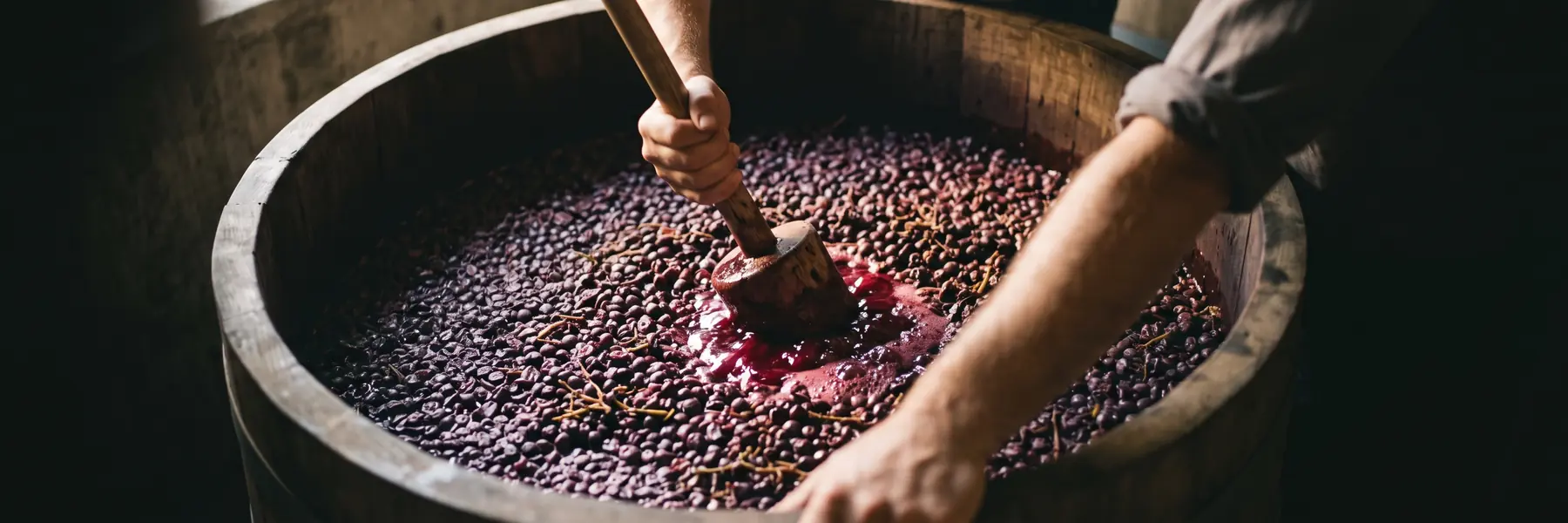
Long, gentle submerged-cap maceration (the traditional Barolo route): three to five weeks, with the cap held under the liquid and no active punching-down after fermentation ends. In the later phase, tannins polymerise into longer, softer chains and bind with what pigment there is. Counter-intuitively, the wine comes out softer than a shorter, harder extraction.
Shorter, moderate maceration (10–14 days): more manageable, less risky, and closer to modern practice. Better if you cannot keep a cap submerged and protected for a month.
Whichever you choose: keep the cap wet, keep a CO₂ blanket, keep the vessel covered, and check for volatile acidity throughout. A long maceration that goes wrong goes very wrong. See tannin management, punch-down vs pump-over and volatile acidity.
Fermentation temperature
Mid-to-high 20s °C. Nebbiolo needs warmth to extract at all, but heat drives off the floral aromatics that are the variety's greatest asset. See fermentation temperature.
Press fractions
Nebbiolo's hard press is punishing. Keep it separate and taste it before you consider blending any back. See our press fractions article.
MLF
Always, and completely. Nebbiolo's malic acidity on top of its tannin is genuinely harsh. See MLF explained.
Ageing — the part that cannot be shortened
Large, neutral wood. Botti of Slavonian oak in the traditional Piedmontese cellar contribute no flavour but supply the slow, continuous oxygen exposure that resolves Nebbiolo's tannin. Small new barriques add vanillin and toast that fight rose petal and tar directly, and the 1990s fashion for them has largely receded.
If you only have small barrels, use old ones. If you only have glass, splash-rack once or twice during élevage to supply oxygen deliberately. Give it eighteen months to two years in bulk before bottling. See barrel ageing basics and racking guide.
Tartrates
A high-acid, low-pH red will drop tartrate crystals in a cold bottle. Cold stabilise or explain them. See cold stabilisation.
Common faults and their causes
| Problem | Usual cause |
|---|---|
| Aggressive, drying, bitter finish | Unripe seeds at harvest; over-extraction; hard press blended in |
| Pale and browning at three years | Normal for Nebbiolo — accelerated by low SO₂ and oxygen ingress |
| Tastes of oak, not roses | New small barrels on a delicate aromatic wine |
| Sharp and thin | Overcropped fruit, or a site that never ripened it |
| Volatile acidity | Long maceration with an exposed or dry cap |
Food pairing
White truffle with egg pasta, braised beef, game, veal, risotto with mushrooms, and aged alpine cheeses. Nebbiolo's acid and tannin need fat and umami; it is a poor match for anything light or sweet.
Tip: Bottle enough Nebbiolo to open one bottle a year for five years, and write the tasting notes down. This is the one variety where an honest early verdict is almost always wrong — a wine that seems a failure at eighteen months is frequently very good at six years, and you will only learn that pattern by having kept the bottles.