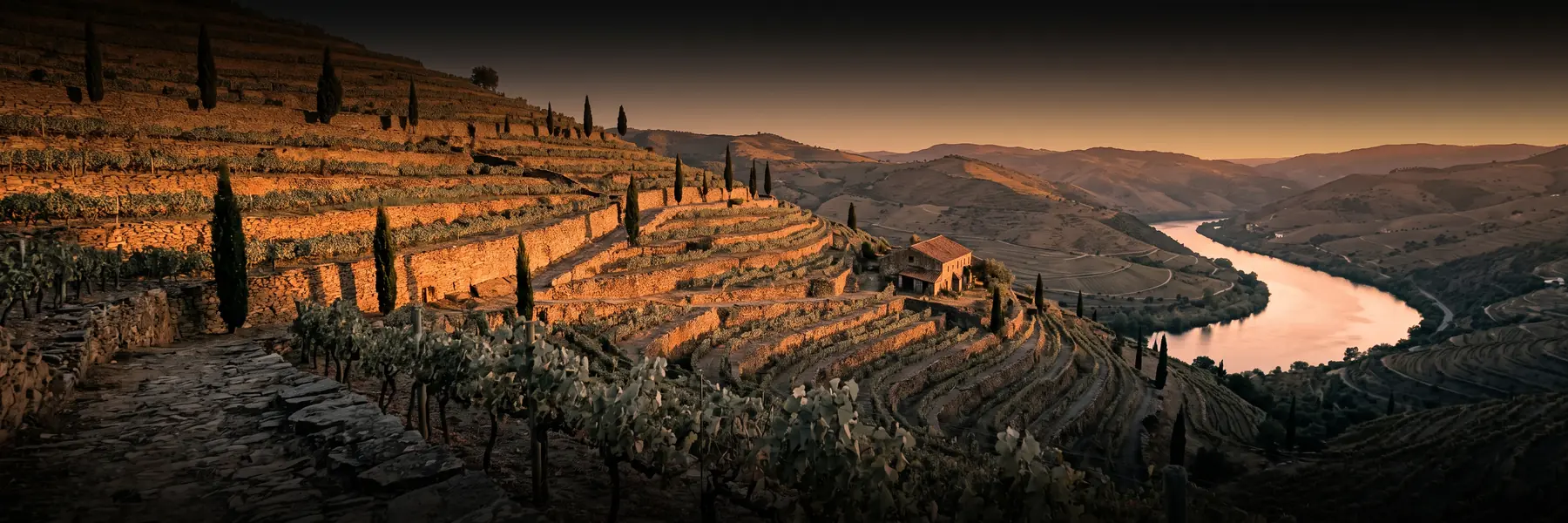
Kamptal & Kremstal — Austria's Riesling and Grüner Heartland
Kamptal & Kremstal — Austria's Riesling and Grüner Heartland
Downstream of the Wachau's famous terraces, two neighbouring DACs quietly make some of Austria's best white wine at half the price. Kamptal and Kremstal share the same grapes, the same climate and the same fundamental soil contrast as their more celebrated neighbour — and that contrast is the single most useful thing in Austrian wine for a winemaker to understand, because it is the clearest available demonstration of one variety, two soils, two wines.
Geography
Both regions sit in Lower Austria, north-west of Vienna, on and around the Danube.
Kremstal wraps around the town of Krems, where the Wachau gorge opens out. It is a transition zone in the most literal sense: steep, terraced primary rock (gneiss, granulite, amphibolite) on the Wachau side, giving way eastwards to deep beds of wind-blown loess on the gentler ground around Rohrendorf and Gedersdorf (Senftenberg, up the Krems valley, belongs with the primary-rock terraces).
Kamptal follows the Kamp river valley north from Langenlois. The same contrast repeats: loess terraces on the lower slopes and, rising above them, the Heiligenstein — an outcrop of ancient sandstone and conglomerate with volcanic material, geologically unlike anything around it, and one of the great Riesling sites of central Europe. The neighbouring Lamm and Käferberg sites are almost as celebrated.
Climate
Continental with Pannonian influence. Warm, dry summers pushed in from the Hungarian plain to the east; cold air draining down from the Waldviertel forests to the north-west at night. The result is a large diurnal swing — warm ripening days, genuinely cold nights — which is precisely what a high-acid aromatic white needs.
Rainfall is low. The Danube and the Kamp moderate temperature and extend the season.
The Two Grapes, and the Two Soils
This is the heart of it.
| Grüner Veltliner | Riesling | |
|---|---|---|
| Prefers | Loess — deep, calcareous, water-retentive, fertile | Primary rock and the Heiligenstein — thin, stony, poor, free-draining |
| Gives | White pepper, lentil, citrus, a broad and fleshy mid-palate; sometimes a tobacco-leaf note with age | Stone fruit, lime, slate-and-spice minerality, piercing acidity, extreme longevity |
| Body | Fuller, rounder | Leaner, more linear, more tense |
Grüner on stony primary rock becomes tense and mineral but can lose its characteristic breadth; Riesling on loess becomes broad and loses its precision. Austrian growers have spent generations matching variety to soil, and it is worth taking seriously — the site-variety fit does more for a wine than anything you will do in the cellar.
Both regions also grow small amounts of Zweigelt, Pinot Noir, Chardonnay (the Morillon name is used only in Styria, not here) and Pinot Blanc (Weissburgunder).
The DAC Pyramid
Austria's DAC system defines a region's typical style. Kamptal and Kremstal both use a three-tier origin pyramid:
- Gebietswein — regional wine; the everyday tier
- Ortswein — village wine, from a named municipality
- Riedenwein — single-vineyard wine, from a named Ried (the Austrian term for a demarcated vineyard site)
Within that, the older stylistic distinction persists in practice: Klassik for fresh, unoaked, moderate-alcohol wines meant for early drinking, and Reserve for riper, more concentrated, longer-aged wines. Reserve wines carry a higher minimum alcohol and later release.
For the precise minimum alcohol levels, release dates and permitted varieties, check the current DAC regulation — Austria has revised its system repeatedly since the DACs were introduced, and the details differ between regions.
Producers
Kamptal
- Weingut Bründlmayer — Willi Bründlmayer; the reference for Heiligenstein Riesling and Lamm Grüner; also excellent traditional-method sparkling
- Schloss Gobelsburg — Michael Moosbrugger; historic monastic estate; Heiligenstein and Lamm, plus the deliberately archaic Tradition bottlings
- Weingut Hirsch — Heiligenstein and Gaisberg; precise, dry, screwcapped
- Loimer — biodynamic, restrained, excellent value
Kremstal
- Nigl — the Riesling Privat from Senftenberger Hochäcker is one of Austria's most celebrated Rieslings
- Salomon-Undhof — long-established, consistently fine
- Malat, Stadt Krems, Sepp Moser — reliable across the range
What These Regions Teach
Match the variety to the soil, not to the fashion. The Grüner-on-loess / Riesling-on-rock rule is a real, reproducible observation about water-holding capacity and vigour. Water-retentive fertile soil suits a vigorous variety that gives breadth; poor free-draining rock suits a variety whose quality depends on struggle and tension. If you are planting, this matters far more than clone selection.
No MLF, and low pH as an asset. Austrian white winemaking is fundamentally reductive and protective: cool ferments, no malolactic, minimal oak, early bottling under screwcap. Riesling and Grüner both depend on malic acid for their structure — see MLF explained. The resulting low pH means SO₂ works efficiently and additions can be modest; read understanding SO₂.
Ferment cool and clean. 13–16 °C, settled juice, an aromatic-preserving strain. See fermentation temperature and choosing your yeast.
Grüner Veltliner's pepper is fragile. The white-pepper character (rotundone, the same compound that makes Syrah peppery) is destroyed by over-ripeness and by warm fermentation. If you grow Grüner and it tastes of nothing in particular, you have probably picked it too late.
Large neutral oak, if any. The Reserve style uses large casks — the point is texture and slow oxygen, not flavour. A new small barrel will erase everything that makes these wines worth drinking. See barrel ageing basics.
Cold stabilise and screwcap. High-acid, high-potassium whites deposit tartrates readily, and Austria has been an early and near-universal adopter of screwcap for exactly the freshness reasons. See cold stabilisation and closure comparison. Run your acid and SO₂ numbers through the calculators.
Our Austria guide covers the country and the Wachau in more detail.
Food Pairing
Grüner Veltliner with Wiener Schnitzel (the classic, and it works), asparagus, artichoke, dill and root vegetables — it handles awkward vegetables better than almost any wine. Riesling with river fish, roast pork, smoked trout, and Asian food. Serve both at 10–12 °C.
Tip: If you grow one white variety on two different parts of your site, vinify them separately for one season, identically, and taste them side by side. It is the cheapest terroir experiment there is, and Kamptal has been running it for two hundred years.