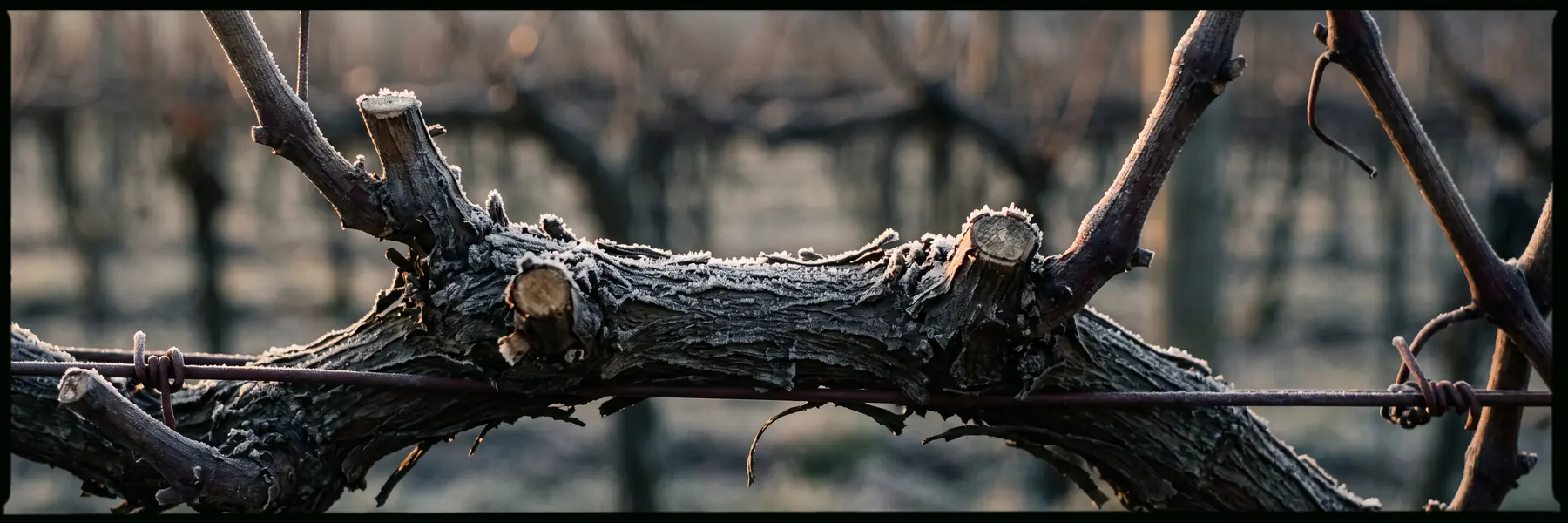
What a Grape Variety Actually Does: Budbreak, Ripening and Disease
What a Grape Variety Actually Does
A variety name on a label tells you about flavour. A variety name on a planting order tells you about dates: when the vine wakes up in spring, when the fruit is ready, and therefore which frosts, which rains and which diseases it will meet along the way.
This page does not tell you what to plant, and be wary of anything that does. The choice depends on your heat summation, your frost risk, your soil, your rainfall at flowering and at harvest, your rootstock, your clone and what your nursery can actually supply — none of which is visible from here. What follows is what these varieties are documented to do.
Every timing here is relative
"Late ripening" means late compared with other varieties in the same place, never a date. Nebbiolo is late in Piedmont and impossible in Kent. Pinot Noir is early in Burgundy and mid-season in Champagne. Timing also moves with clone, rootstock and season.
Read the ordering, not the label. The useful question is not "is this late?" but "is this later than the thing I already grow, and can my autumn carry it?"
Two dates matter, for different reasons
Budbreak decides frost exposure. An early-budding variety in a frost-prone site loses crop to a single cold night in April, and no later decision recovers it. This is why late-budding varieties persist in places their ripening alone would not justify.
Ripening decides whether you get fruit at all, and what state the autumn is in when you pick. A very late variety in a wet climate is not a slow variety; it is a variety that will be harvested in the rain.
The two are independent. Nebbiolo buds very early and ripens very late — the longest season of any major variety, and the reason it is grown in so few places.
Disease susceptibility is a tendency, not a forecast
The ratings below follow from things that travel between regions: how tight the bunches are, how thick the skins, how dense the canopy, how early the vine wakes. Pressure, though, belongs to your season — a resistant variety in a wet August still gets sick, and a susceptible one in a dry year may show nothing.
Only susceptibilities that are consistently reported are listed. Where sources genuinely disagree, the disagreement is printed rather than averaged away.
The tables
White varieties
| Variety | Budbreak | Ripening |
|---|---|---|
| Chardonnay | Early | Early |
| Sauvignon Blanc | Mid | Mid |
| Riesling | Late | Late |
| Pinot Gris | Early | Early |
| Chenin Blanc | Early | Late |
| Sémillon | Mid | Mid |
| Viognier | Early | Mid |
| Gewürztraminer | Early | Early |
| Muscat Blanc à Petits Grains | Early | Early |
| Albariño | — | Mid |
| Grüner Veltliner | Mid | Late |
| Müller-Thurgau | Early | Very early |
| Assyrtiko | — | Mid |
| Furmint | Early | Late |
| Solaris | Early | Very early |
| Seyval Blanc | Mid | Early |
| Vidal Blanc | — | Late |
Red varieties
| Variety | Budbreak | Ripening |
|---|---|---|
| Cabernet Sauvignon | Late | Late |
| Merlot | Early | Mid |
| Pinot Noir | Early | Early |
| Syrah | Mid | Mid |
| Grenache | Early | Late |
| Tempranillo | Early | Early |
| Sangiovese | Early | Late |
| Nebbiolo | Very early | Very late |
| Malbec | Mid | Mid |
| Cabernet Franc | Mid | Mid |
| Petit Verdot | Early | Very late |
| Mourvèdre | Late | Very late |
| Carignan | Late | Very late |
| Gamay | Early | Early |
| Touriga Nacional | — | Mid |
| Aglianico | Early | Very late |
| Blaufränkisch | Early | Late |
| Zweigelt | Mid | Early |
| Rondo | Early | Very early |
| Regent | Mid | Early |
Variety by variety
Cabernet Sauvignon
buds late · ripens late
Small berries, thick skins, high pip-to-pulp ratio — the origin of both its tannin and its colour.
Late budbreak dodges spring frost; late ripening means it needs a genuinely warm site to avoid green, herbaceous character. Thick skins are why it resists bunch rot better than most.
Susceptibility: powdery mildew high, botrytis / bunch rot low.
Not claimed here: vigour — reported anywhere from moderate to very high depending on rootstock and soil water
Merlot
buds early · ripens mid
Larger, thinner-skinned berries than Cabernet Sauvignon.
Buds and ripens earlier than Cabernet Sauvignon, which is why the two are so often planted together — different frost and harvest risks on one estate. Prone to coulure in a cold, wet flowering.
Susceptibility: botrytis / bunch rot high, downy mildew high.
Pinot Noir
buds early · ripens early
Thin skins in tight, compact bunches.
Early budbreak puts it squarely in the path of spring frost. Tight bunches and thin skins make bunch rot the defining risk in a wet autumn. Famously mutable — the number of distinct clones is a consequence of that instability, not a marketing choice.
Susceptibility: botrytis / bunch rot high, powdery mildew moderate.
Syrah
buds mid · ripens mid
Wants warmth to ripen its tannins but loses aromatic lift and acidity if the site is too hot — a narrower window than its spread across the world suggests.
Disputed: 'Syrah decline' — leaf reddening and graft-union failure — is widely reported, but its cause is not settled, and explanations range from graft incompatibility to virus.
Not claimed here: vigour — strongly rootstock-driven
Grenache
buds early · ripens late
Accumulates sugar readily, so it makes high-alcohol wine easily and balanced wine less easily. Drought tolerant and traditionally bush-trained. Prone to coulure, which is a large part of its yield variability.
Susceptibility: downy mildew high.
Tempranillo
buds early · ripens early
The name is from 'temprano', early — it ripens well ahead of the Grenache it is usually blended with. Naturally moderate acidity, which is why cooler, higher sites are prized for it.
Sangiovese
buds early · ripens late
Thin skins.
Early to bud and late to ripen — a long hang time that makes it sensitive to a poor autumn. Enormous clonal variation, so blanket statements about it are usually statements about one clone.
Susceptibility: botrytis / bunch rot high.
Nebbiolo
buds very early · ripens very late
The longest season of any major variety: first to bud, last to pick. High tannin and high acid with relatively pale colour — the pigment is unstable and browns young, which is why mature Nebbiolo is orange at the rim.
Malbec
buds mid · ripens mid
Prone to coulure and to frost damage, which is much of why it retreated in Bordeaux and thrived where springs are drier. Deep colour with softer tannin than Cabernet Sauvignon.
Cabernet Franc
buds mid · ripens mid
Ripens roughly a week or two ahead of Cabernet Sauvignon and tolerates cooler sites and colder winters, which is why it works in the Loire where Cabernet Sauvignon does not. Under-ripe fruit is markedly herbaceous.
Petit Verdot
buds early · ripens very late
Later than Cabernet Sauvignon, which in Bordeaux means it often failed to ripen at all — hence its small share of a blend it contributes colour and tannin to. Far more reliable in warm climates.
Mourvèdre
buds late · ripens very late
Needs real heat and a long season; unripe it is hard and reduced. Tends towards reductive character in the cellar, so it is usually handled with more oxygen than its neighbours.
Carignan
buds late · ripens very late
Very productive if allowed to be, and the reason it was both widely planted and widely pulled up. Old, low-yielding bush vines are the source of its modern reputation, which says as much about vine age and yield as about the variety.
Susceptibility: powdery mildew high.
Gamay
buds early · ripens early
Early on both counts, which suits cool sites but exposes it to spring frost. Low tannin and bright acidity; the carbonic maceration it is associated with is a winemaking choice, not a property of the grape.
Touriga Nacional
ripens mid
Very small, thick-skinned berries.
Naturally low-yielding with a high skin-to-juice ratio, which is the source of its concentration. Historically difficult to grow consistently, and much of its modern success follows clonal selection work rather than a change in the variety.
Aglianico
buds early · ripens very late
Often picked into late October or November, which makes it viable only where autumns stay dry and warm. High in both tannin and acid, so it is austere young.
Blaufränkisch
buds early · ripens late
Early to bud and late to ripen, so it needs a long season despite being grown in cool Central European regions. Retains acidity well and has firm tannin for its climate.
Zweigelt
buds mid · ripens early
A 1922 crossing of Blaufränkisch and St. Laurent. Ripens earlier and more reliably than either parent, which is the whole reason it exists and why it is now Austria's most planted red.
Chardonnay
buds early · ripens early
Early budbreak is its main viticultural liability — Chablis frost defences exist because of it. Otherwise unusually adaptable, which is why it grows nearly everywhere and why its character is so heavily a product of site and cellar.
Susceptibility: powdery mildew high, botrytis / bunch rot moderate.
Sauvignon Blanc
buds mid · ripens mid
Vigorous and dense-canopied, so it demands canopy management: shade both raises disease pressure and pushes the aromatics towards the green end. Loses its aromatic signature quickly if picked over-ripe.
Susceptibility: powdery mildew high.
Riesling
buds late · ripens late
Late budbreak avoids frost and hard wood gives it real winter hardiness — the combination that lets it sit as far north as it does. Holds acidity at high ripeness, which is why it can be sweet without being flabby, and takes noble rot cleanly.
Pinot Gris
buds early · ripens early
A colour mutation of Pinot Noir and shares its habits — early budbreak, tight bunches, thin skins. The pink-grey skin can give juice a copper tint if pressed hard or left on skins.
Susceptibility: botrytis / bunch rot high.
Chenin Blanc
buds early · ripens late
Ripens unevenly within a bunch, which is a nuisance for a dry wine and an advantage for a sweet one — successive passes through the vineyard are the traditional answer. Very high natural acidity underpins its whole range from sparkling to sweet.
Susceptibility: botrytis / bunch rot high.
Sémillon
buds mid · ripens mid
Thin skins.
Its botrytis susceptibility is the point in Sauternes and the problem everywhere else. Naturally low acidity, which is why it is so often blended with Sauvignon Blanc.
Susceptibility: botrytis / bunch rot high.
Viognier
buds early · ripens mid
Unforgiving on both sides: picked early it is neutral, picked late it loses acid and turns heavy, and the aromatic window between the two is short. Low and irregular yields are characteristic rather than a fault of management.
Gewürztraminer
buds early · ripens early
Pink-skinned.
Naturally low in acidity and high in sugar, so the wines are broad and the picking date matters more than usual. Pink skins can tint the wine if skin contact is extended.
Muscat Blanc à Petits Grains
buds early · ripens early
Muscat Blanc à Petits Grains is the oldest and finest of the Muscat family and is distinct from Muscat of Alexandria despite the shared name — an important distinction when reading old texts, which often do not make it.
Susceptibility: powdery mildew high, botrytis / bunch rot high.
Albariño
ripens mid
Small berries with notably thick skins.
Thick skins are why it copes with a wet Atlantic climate that would rot a thinner-skinned variety, and traditional high pergola training keeps air moving through the canopy for the same reason. High acidity even when fully ripe.
Grüner Veltliner
buds mid · ripens late
Vigorous and productive, and quality tracks yield restraint closely — the difference between everyday and serious Grüner is usually a decision made in the vineyard. Wants deep soil with water; it suffers on dry sites.
Müller-Thurgau
buds early · ripens very early
A Riesling crossing bred in 1882 to ripen early and reliably in cool climates, which it does. The trade is low acidity, modest flavour and real disease susceptibility — it was planted enormously for the first quality and pulled up for the others.
Susceptibility: botrytis / bunch rot high, downy mildew high.
Disputed: Its second parent was long given as Silvaner; DNA work since has identified it as Madeleine Royale. Older books say Silvaner and are wrong.
Assyrtiko
ripens mid
Unusual in retaining high acidity in a hot climate, which is why it makes structured dry whites on Santorini. Traditionally trained as a basket, kouloura, to shelter fruit from wind and sun rather than for any ripening reason.
Furmint
buds early · ripens late
Thin skins.
Its willingness to take noble rot is what makes Tokaji possible, and the same thin skin makes a dry Furmint vintage-dependent. Very high acidity carries the sweetness in the sweet wines.
Susceptibility: botrytis / bunch rot high.
Solaris
buds early · ripens very early
A modern fungus-resistant crossing (Freiburg, 1975) and one of the few varieties that ripens dependably in Ireland, Britain and Scandinavia. Accumulates sugar so fast that acidity can fall away before the flavours arrive — picking early is usually the right call rather than a compromise.
Susceptibility: powdery mildew low, downy mildew low.
Not claimed here: Precise resistance ratings vary between trial sites and are being re-measured as pathogen populations adapt — 'low' here means markedly lower than vinifera, not immune.
Seyval Blanc
buds mid · ripens early
A French-American hybrid long used in England for still and sparkling wine. Reliable and productive in cool, damp conditions; tight bunches mean rot is still the main autumn risk despite good mildew tolerance.
Susceptibility: powdery mildew low, botrytis / bunch rot moderate.
Rondo
buds early · ripens very early
Bred for deep colour and early ripening in cool climates, which is exactly the problem it solves — most cool-climate reds are pale. Early budbreak makes frost the main risk. Acidity stays high, so it is often blended or handled to soften it.
Susceptibility: downy mildew low.
Regent
buds mid · ripens early
A fungus-resistant crossing that allows a substantial reduction in spraying, which is its whole purpose. Deep colour and moderate tannin.
Susceptibility: powdery mildew low, downy mildew low.
Disputed: Its downy mildew resistance has weakened at some sites since release as pathogen populations adapted — resistance bred into a variety is not permanent, and treating it as permanent is the practical mistake.
Vidal Blanc
ripens late
Very thick skins.
Thick skins let the fruit hang into hard frost without splitting, which is why it dominates Canadian icewine. Winter-hardy wood and high acidity.
What is missing, and why
This covers 37 of 135 grape varieties in our vocabulary. The gap is real and stated rather than hidden: a partial reference that looks complete is worse than one that admits its edges.
Two kinds of claim are deliberately left out throughout.
Vigour rarely appears. It is driven so strongly by rootstock, soil water and nitrogen that a bare "high" or "low" against a variety name is closer to a rumour than a fact. Where a variety's vigour is genuinely characteristic, it is described in words in its own entry.
Yields, sugar levels and harvest dates are absent entirely. Those are properties of a site and a season, not of a variety, and a number here would be quoted back as if it were a target.
Compiled from general viticultural literature rather than transcribed from any single reference work. If something here contradicts your own vines, your vines are the better source: this is a starting point for a conversation with a local agronomist, not a substitute for one.