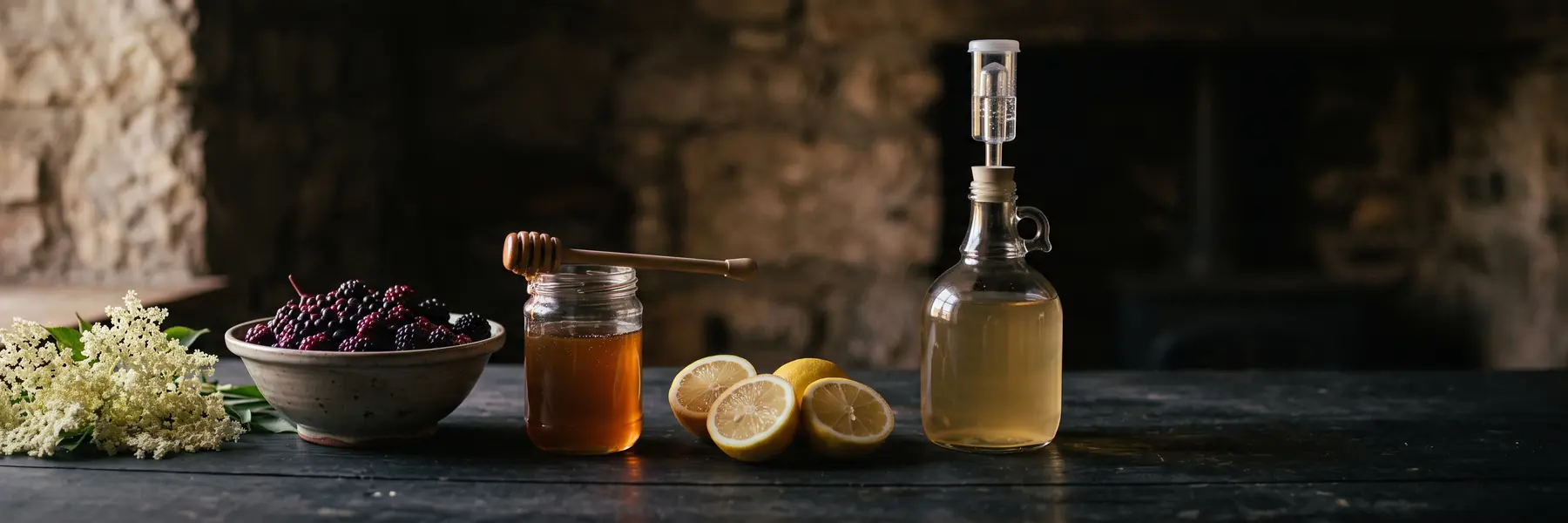
Elderflower Wine: A Step-by-Step Recipe
Elderflower Wine: A Step-by-Step Recipe
Elderflower wine is one of the most rewarding country wines to make. It captures the fleeting fragrance of midsummer in a bottle — pale gold, delicately floral, reminiscent of muscat or lychee. The flowers are free, the process is simple, and the result is better than anything you can buy.
Picking Elderflowers
When: Late May to mid-July in the UK and Ireland, depending on the year and location. Pick when the flowers are fully open — creamy white, heavy with pollen, intensely fragrant. Underripe (green) flowers smell sharp and unpleasant; overripe (browning) flowers smell musty.
How: Pick in dry weather, mid-morning, after any dew has evaporated. Shake each head gently to release insects before bringing inside. Do not wash — you'll wash off the wild yeasts and pollen that contribute to the aroma.
How many: For a 5-litre batch: 20–25 large flower heads (the size of a saucer). More flowers = more intense fragrance; fewer = lighter wine.
Variety note: Use only common/black elder, Sambucus nigra (its North American subspecies canadensis is also fine). Avoid dwarf elder (Sambucus ebulus) — a shorter, herbaceous plant with similar white flowerheads whose flowers and berries are toxic — and any white-flowered plant you cannot positively identify as elder. When in doubt, confirm identification before picking.
Ingredients (5-litre batch)
| Ingredient | Amount |
|---|---|
| Fresh elderflower heads | 20–25 large |
| Water | 4.5 litres |
| Sugar | 700g |
| Lemons (zest and juice) | 2 |
| White grape juice (optional, adds body) | 500mL |
| Yeast (Lalvin 71B or EC-1118) | 1 sachet |
| Yeast nutrient (Fermaid-K) | 2g |
| Potassium metabisulphite | 0.5g |
| Pectic enzyme | 0.5g (optional, improves clarity) |
| Acid blend / citric acid | 1–2g (optional, to balance pH) |
Equipment
- 5L glass demijohn or carboy
- Airlock and bung
- Hydrometer and trial jar
- Thermometer
- Large pot (for boiling water)
- Muslin cloth or fine strainer
- Funnel
- Auto-siphon
Step-by-Step Method
Day 0: Prepare the must
-
Shake the flower heads over a bowl to release insects. Remove any large stems but leave the small florets attached — green stems are bitter.
-
Place flowers (and lemon zest) in a large sanitised bucket.
-
Dissolve sugar in 1 litre of boiling water. Pour over the flowers. Add remaining cool water (4–4.5L) to bring the temperature down to below 40°C.
-
Squeeze lemon juice into the must. Add pectic enzyme.
-
Stir in 0.5g potassium metabisulphite (or 1 Campden tablet) — roughly 50–60 mg/L SO₂ in a 5L batch, the standard pre-ferment dose (see understanding SO₂). This knocks back wild flora and preserves the floral aromatics.
-
Cover with muslin and leave in a cool place for 24–48 hours.
Day 1–2: Measure, strain, and pitch
-
Strain through muslin, pressing the flower heads gently to extract the liquid. Don't squeeze hard — you'll extract bitter compounds.
-
Measure OG with a hydrometer. Target: 1.075–1.085. If lower, dissolve additional sugar in a small amount of warm water and add to reach target.
-
Check pH. Target: 3.2–3.6. If higher (above 3.6), add 1–2g citric or tartaric acid.
-
Rehydrate yeast (71B) in 50mL of warm water at 35–40°C. After 15 minutes, pour into the must.
-
Add yeast nutrient.
-
Pour into sanitised demijohn, fit airlock, store at 18–22°C.
Days 3–14: Primary fermentation
Fermentation should start within 24–36 hours — bubbling airlock, sometimes light frothy activity. 71B ferments elderflower gently and fragrantly at 18–22°C. Check gravity every 3–4 days.
When gravity reaches 1.005–1.010, the fermentation is almost complete.
Day 14–21: Rack and condition
When gravity is stable below 1.000 for 48 hours, rack into a clean sanitised demijohn. Leave as little headspace as possible. Add half a crushed Campden tablet to protect the wine.
Leave for 4–6 weeks. The wine will clarify on its own; fine lees will settle to the bottom.
Week 6–8: Final rack and optional sweetening
Rack again, leaving fine sediment behind. Taste the wine.
Elderflower wine can be bottled dry (all fermentable sugar consumed), off-dry, or slightly sweet. If you want to back-sweeten:
- Stabilise with potassium sorbate (0.25g per litre) + Campden tablet — this prevents the yeast from re-fermenting the added sugar.
- Wait 24 hours.
- Dissolve 30–50g sugar in a small amount of wine and stir in gently.
- Taste and adjust.
Bottling
When the wine is clear, stable, and at your desired sweetness, bottle into clean, sanitised bottles. Cork and label. Elderflower wine is best drunk young (within 12–18 months) while its floral aromatics are at their brightest.
Troubleshooting
Wine is not clearing: Add a fining agent — Superkleer (kieselsol + chitosan) or bentonite; if the haze is pectic, pectic enzyme is the fix. (A Campden tablet is SO₂, a preservative — it does not clear haze.) Temperature fluctuations can cause permanent hazes — keep the demijohn in a stable location.
Flavour is too floral/intense: More elderflower heads were used than needed, or the flowers were left to steep too long. In future batches, use fewer heads or steep for a shorter time.
Flat, lacking freshness: The flowers may have been past their best. Pick earlier next year, or add 1g citric acid at tasting to assess whether acid brightens the wine.
Tip: Make a small 1-litre trial batch using different flower quantities (15 heads vs 30 heads in scaled amounts) to calibrate the intensity you prefer before committing to a full batch.